Memphis Memories and a Patriot’s Daughter

I’m a lifelong learner. I love digging through history to find people who inspire me…hearing about new dinosaur fossils being discovered around the world…reading poems, short stories, and novels that make me think and draw me into the story so deeply that I feel part of the author’s created world.

While reading some notes about some of the people buried in a historic cemetery in my area, I recently learned something about my own hometown. I did not know that Dorothea Spotswood “Dolly” Henry Winston, the daughter of Patrick and Dorothea Henry once lived in Memphis. She’s buried in Elmwood Cemetery, so you can visit her grave if you visit. She was born in Williamsburg, Virginia, on August 2, 1778, and died in Memphis, Tennessee, at age 75 on June 17, 1854, at the home of her daughter.

Though her father’s words are easy to find, I couldn’t find much information about her life outside of Virginia, but I decided to write a short story (historical fiction) that introduces you to a little bit of her story.

Liberty and Lunch

By Chris Pepple ©2026

I gathered my belongings and stepped onto the deck of the steamboat. The awe-inspiring monster I traveled on offered me a quick way to reach my daughter and her husband in Memphis as it billowed smoke as if a dragon deciding whether it would protect or devour me along the journey. As I felt the churning of the waves of the Mighty Mississippi lapping at the edge of the boat, I prayed daily to myself: Dear Lord, keep the fires of this dragon contained in its own boilers. Help us avoid the fires that have taken the lives of other travelers.

Here I was, a woman in my 70s, on a new adventure that I had not seen coming. I had eaten my breakfast this morning on this vessel, trying not to think about what was ahead. Now, as I stared at the bluffs and the shoreline I would soon reach, I closed my eyes and thought back to the place I thought I would spend my final days—Red Hill, Virginia. I could picture our modest main house with my father proudly walking in to greet his family. I could smell the flowers blooming, hear my siblings laughing, and feel the wind blowing through the Osage orange tree.

I opened my eyes and saw the reality of the cobblestones and mud on the banks before me. I could hear the workers preparing for us to disembark. So many were excited to be landing in this growing city, but I saw nothing before me that felt comforting.

“Are you Dolly?” I heard a voice behind me calling out.

“Excuse me?” Dolly? Who knows me here to call me by that name? I surely have no friend here yet.

“Sorry, Ma’am. Are you Mrs. Dorothea Henry Winston?”

“Yes,” I replied, feeling tired and wanting to find someone familiar.

“Your daughter left me instructions to assist you off the boat and up the hill to her husband’s waiting wagon.”

I nodded. Elvira and James had been so kind to me over the past few years. After George died twenty-one years ago, I felt a bit lost. Grief over his death and the loss of four of our children through the years seemed to be a constant companion. Now—well, another change loomed before me. I accepted the help off the steamboat, not wanting to slip on the cobblestones or fall off the planks and into the mud that seemed to prey on this landing as if one more layer would swallow it forever. Memphis—my new home with my daughter and her family.

“Dolly, you made it!” my son-in-law called out, being one who could call me Dolly. “I hope your trip went well.”

“So good to see you, James,” I replied as he reached for my bags. “I’ll hold on to this one. It has a few special items in it.” I held that all the way to the home Elvira and James had been preparing for us to live in. They arrived months earlier to have things ready. I entered the house and could feel the care they had both put into it, hoping it would begin to feel like home to me. I had been away from Virginia for years—moving with them to Alabama after George died—but had always hoped to make my way back there for my final days. This house would have to do instead.

“Mother, let’s invite a few ladies over for lunch,” Elvira said two weeks into my stay at our new house. “We could have some chicken or rabbit with biscuits and some okra or greens.”

“It’s time I became a bit more social, I suppose. If we do that, I’d like to use something special at the table. Wait while I get it.” I went to my room and pulled out the only unpacked bag I had left. I pulled out two cloths with items wrapped in them. I smiled as I held them in my hands.

I went back out to our dining table and placed the cloths before Elvira. “These should be with you now,” I said as I unwrapped the largest cloth. Elvira gasped as she saw the items before her—eight sterling silver shell-patterned pistol handled knives, with eight matching three-pronged forks, and eight spoons.

“Mother, where did you get these?” she asked as she ran her fingers over the knife handles, admiring the craftsmanship.

“I’ve had these for years. Brought them from Red Hill when I left. I just never unpacked them. They were part of a wedding gift from my mother and father, handed down from our family,” I answered, once again closing my eyes and thinking of my parents and our homes in Virginia.

“What’s in the other cloth?”

“A tea cup,” I said as I pulled out a small china cup with its high handle and pink flowers with shamrock green leaves. “This is still mine for now. It reminds me of both the fragility and the beauty in life.” I paused before adding, “I think I’ll rinse this and make myself some tea now.”

Three days later, I admired the silverware as we sat around the table with women of various ages who were dear to Elvira and would become dear to me—mothers and daughters facing this growing port city together.

“I feel like I’m sitting with royalty,” Mrs. Thompson said, looking in my direction. “Tell us more about your family. I’ve read about your father a bit.”

“Well, I certainly don’t feel like royalty. Our lives are all of equal importance. Our joys and sorrows are equally felt and shared.”

“But you’re the daughter of Patrick Henry. That name’s known through all of the states—a founding father and a Virginia governor.”

“To me he was simply ‘Father.’ My mother and my father taught me how to read and how to listen, how to find my true self and how to respect the lives of others. I grew up in a house full of love and full of a desire to learn. I suppose his life is that of an American patriot who will be talked about when people pen the history of our nation, but to me he’ll be remembered for all of our long walks and our evening talks.”

“You’re lucky to have been educated and given so many opportunities in life,” a young woman who was sitting near Elvira said. “I’ve been farming for so long that I can’t even remember the last time I walked into a school room or held a book in my hand. Tell me more about what’s happening in other parts of the country and the political discussions I hear when I’m at the general store.”

“I can do more than tell you,” I said as I pardoned myself from the table and went into my room. I came back with three books and some letters tied together with a ribbon. “Here are some of my father’s letters I kept that talk about all that he worked for in this nation—the Bill of Rights he wanted to ensure we all had. I also have a few books that might interest you. The letters can be read here, but you can borrow the books. I’m having even more shipped in soon.”

“Liberties and freedom—people are still arguing about that today. Who has which liberties and who is truly free,” Mrs. Thompson added. “I try to focus on more basic matters such as what our church families face and what food needs to be put on the table. Illness runs through this town so often. Focusing on freedom isn’t going to cure or feed any of us.”

The conversation continued about the importance of speaking out for the rights of all people in our growing nation while also working to feed our families and provide medical care for our communities.

The lunch turned into a weekly occurrence with new faces joining us each week. When the weather was nice, we picnicked out back. With the cold or rain, we filled every chair in the house and filled our tables with food from each family.

During one lunch more than a year later, I looked at our group and said, “My father once wrote, ‘My earnest wish is that Christian charity, forbearance and love may unite all different persuasions as brethren.’ I truly wish that as well. You have made me feel at home here, though I longed to be back in my family home in Virginia. You gave me a purpose and a hope through these lunches—that my father’s wish for all people to be respected in this nation will still be something others are willing to stand for today.”

Maybe Dorothea Spotswood “Dolly” Henry Winston started the Memphis tradition of gathering for book club discussions and creating space for diverse beliefs to share a meal and remember what her father hoped for.
First Weekend Out

Sometimes I have a lot of noise in my life. I have a long to-do list that grows longer when people try to make helpful suggestions on what to do to “improve” my life…join more online or in-person communities, log more reading, find a new diet, join their work-out group, change my body, change my routines. Don’t get me wrong—there’s nothing wrong with any of these suggestions. I do watch what I eat because of health conditions. I do read quite a lot. I walk at least a minimum of a mile daily and stretch morning and night. I teach and edit and write because I love it.

The noise comes, though, when I feel pressured to change to be someone else…to compete with someone…to binge watch a show just because everyone else is talking about it…to log how many books I read last month. At my age, I realized that I need to do things because they are right for me and do them when they are right for me.

I don’t want to go through life competing with anyone. I also don’t want to carry unnecessary guilt because I failed to reach a reading goal or didn’t make it to a scheduled work-out. I like accountability in life, but there’s a loving way to wish the best for me and there’s a noisy way to make me feel as if I need to completely change who I am in order to keep up with society’s latest trends.

Here’a a very short story (just for fun) to help us remember that we can walk away from the noise.

First Weekend Out

By Chris Pepple

We sat in the restaurant in Eureka Springs celebrating the first dinner of this year’s “First Weekend Out.” For the past five years, my friend group had driven into the Arkansas mountains on the first full weekend of the year. Everyone came without children, dates, or spouses—just the six of us chatting about our holidays and resetting ourselves for the new year ahead. Last year, the snow kept us indoors most of the weekend. This year’s warm spell let us take our talks out of our rooms and walk to a nearby restaurant to share chicken pesto flatbread pizzas and vegan wraps with avocados and artichokes.

“Look at this,” Elizabeth smiled, holding her phone up. “Let’s all download this app and keep up with our exercise goals together. Maybe challenge each other and log our weight loss. I need to fit into my size eight jeans again this year.”

“Size eight?” Robin asked with a smirk on her face. “I’ll challenge you to a size six. Send me the link to that. I’m in.”

I don’t guess I’ll mention that I’m a size ten, I thought to myself as I opened the link she sent. And I’m only that because of being so sick in October. Otherwise, I’d still be sitting in this chair in my size twelve pants. I looked over at Emily. She pretended not be bothered, but I could tell she would rather be anywhere else. As beautiful as I knew she was, I also knew she was self-conscious about talking about weight. “Hey,” I blurted out, hoping to change the subject, “it’s supposed to be nice tomorrow. Let’s hike after lunch.”

Emily and I pulled up our trail apps to decide which one to take. While we were chatting, Sandra interrupted. “Sarah, did you finish your online profile? You have to meet someone so you can tell us who you’re almost engaged to next year.” I could feel my cheeks redden. “I still think Michael was a great fit for you.”

“Michael was a great fit for himself,” I replied. “Very self-absorbed. Let’s hike the Lake Leatherwood trail if it’s in good shape. I’ll ask at the desk before we call it a night.” That suggestion thankfully succeeded in changing the conversation away from my dating prospects.

Before the last set of music had been played by the band, Jenn had passed out journals so we could set our resolutions for the year. She had printed off each of our goals from last year so we could assess how we did in meeting them. We could score ourselves by the percentage of each goal achieved. If I hated math and percentages in high school, I certainly hated it here in a restaurant with music and friends. What percentage of people would think this is fun? I wondered as I stared at my printout and the journal I was supposed to fill as I rated myself.

When my phone vibrated, I grabbed it and announced I had to take a call. I picked up my journal and walked away, heading outside as the call went to voicemail. I considered going to the room and texting that I didn’t feel well, but the night sky seemed to be calling me.

As I made my way down the path, I spotted a roaring fire in the fire pit just off the walkway. I could hear people chatting and stopped to enjoy the sound of their voices mixed with occasional laughter. I didn’t realize someone had walked up behind me.

“You should join them,” the deep voice behind me said as I jumped a bit. “Sorry—didn’t mean to scare you. I’m Justin. I was just bringing more wood for the fire. It’s a great community space. There are some extra seats if you want to hang out.”

“Well, I’m with friends at the restaurant. I probably should get back,” I said as I glanced back at the building I had left.

“The night’s too nice to go back in there. The weather’s going to be horrible next week. Enjoy the outdoors and the stars while you can.”

I followed him over and found a seat on a bench, sharing it with one other person. Everyone around the fire introduced themselves, and we all chatted about where we were from. The woman in a beautifully knitted lavender sweater who shared the bench with me added, “We were just talking about the books we’ve read lately—mostly romance novels.”

“So, what are your reading goals for the year?” I asked, thinking I would have something to write in my resolutions journal if I came up with a goal for myself.

“Oh, I don’t set any reading goals,” the woman across from us added as she leaned a bit closer to the fire. “I just read for fun.”

“Me, too,” the woman in the lavender sweater added.

The group started laughing about some of the books they read and the trips they were on when they read them. They seemed at peace with the evening and with themselves, even though I could tell their lives were far from perfect.

“You haven’t said anything lately,” the woman on my bench said. “Are we keeping you from writing?” she asked as she pointed to my notebook.

I glanced at last year’s resolutions on top and realized I didn’t really want any of those goals to come true. I wasn’t looking for marriage or a perfect body size or a promotion at work. I wanted this—time around fires, books to read, and time to see the stars. No lists. No percentages to remind me I failed at some things. “Oh, no. I just brought this out to help you keep the fire going,” I said as I tossed it in the middle of the flames and leaned back and looked up at the stars and smiled for the first time in a long while.

Shifting the Bowl

I write this story in 2006 after watching friends face losses in their families and after I faced losses in my own life. Grief comes to each of us in so many different ways. Sometimes the grief is hard to process immediately because of the shock of the death or because we face challenges in handling the financial affairs of the family member or the details in planning a memorial service. Often we are also trying to “hold it together” so we can let other families members lean on us in their grief. Once we have begun to recognize and process our grief, however, some memories come to us with sweet reminders of the person. We can remember them without the depth of pain that we once felt we were drowning in. We may still be hit with those waves of grief from time to time throughout life, but we can also cherish the sweet memories that stay with us and remind us of the joyful moments we spent with our friends or family members in the past. This was originally published in my first book of short stories, Look to See Me: A Collection of Reflections.

“Shifting the Bowl”

A Short Story by Chris Pepple ©2006

         I shifted the bowl on my coffee table so I could dust and get ready for the evening.  Six couples from my husband’s new firm were coming by for dessert and I knew they would come down and watch TV.  I had three hours left to get the pies ready and eat a light dinner. Really that was plenty of time, but I felt frustrated by the way the afternoon was going.  I always put so much pressure on myself to get things perfect.  Plus, I really wasn’t thrilled with the idea of having company. 

            Daniel wasn’t thinking the way I think when he invited them over. I thought we still needed to finish unpacking boxes and hanging pictures before we even thought of entertaining anyone. But he seemed excited about the idea, so I went along. I know he wants to make a good impression on his new co-workers and their families. I also know that he was both nervous and excited about this move for us, so he considered guests a good way for us both to feel a part of this place. He felt a little guilty about taking me away from so many friends, so inviting some women into the home gave him hope that I would bond with one or two of them.

            I swished my dust rag across the table and knocked over the bowl and the golf magazines beside it.  Maybe I should just put this bowl away or find a place for it in the guest bedroom.  It didn’t seem to go with the décor of an entertainment room.  I desperately needed to work on the color scheme in the room. I headed upstairs with the bowl, but I had to stop and answer the phone on the way.  I grabbed the cordless and kept walking.

            “Hey, Dad.  How’s your day going?” I asked as I grabbed a couple of towels to take up with me.  I enjoyed chatting with my father on most days, so I thought his call would be a nice accompaniment to my chores. I stopped in the middle of the staircase when I realized he was crying, however.  “Dad, what is it?” I asked even though I didn’t feel prepared to know. If he was crying, the news must be hard to handle. My father was the rock in our family. He held me when I cried, but he rarely cried in front of me.

            “Your Mom’s here at the hospital.  I had to call the ambulance.  I just didn’t know what else to do. I’ve never seen her like this. She…” his voice drifted away for a moment. “Oh, the doctor’s here.  Wait, your brother just walked in, too.  I’ll have him call you back. Pray, Sweetheart.”

            Before I could respond, I heard a dial tone. I couldn’t move from my spot on the stairs.  I needed more information. I needed him back on the line with details. I needed him to say, “I’m sure she will be fine.” More than anything I needed to hear my mother’s voice. I wanted her to tell me she would be fine. I sat on the steps and breathed deeply as I hugged the bowl and towels close to me. My prayers for my mother flowed through me with each breath, prayers for her healing, for her comfort and for her voice to be on the line with the next call.

            I wondered what to do next.  I tried to call Daniel at the office, but the receptionist said he had gone to a meeting. He didn’t answer his cell, so I left a message for him to call back.  In frustration, I dialed my brother’s cell phone. No answer there either. I shouldn’t have even tried when he was talking to the doctor, but I felt helpless in the moment.

             I knew Ben would call me soon. My brother carried the same strength as my father. He would assess the situation, and then he would call me with his formal big brother voice to let me know that he was handling the details. After a few minutes on the phone, his tone would change to let me know he was my protective big brother who would help make things better and would keep me updated. Before we ended the call, he would say something ridiculously funny to make me smile and put me at ease.

            No need to start driving to Vicksburg until he called to let me know if Mom and Dad needed me there.  I should be wise and just stay put until I had news. After all, there was no need for panic. Maybe Mom’s problem was just a mild reaction to her new medicine. Or maybe Dad just overreacted. He usually didn’t, but then again he could be really overprotective of Mom at times, especially as they had aged.  My Dad never wavered in his love for my mother and for all of us in his family. He could have been worried about her and wanted to have her checked rather than let a pain or a minor problem blossom into something bigger.

            An incoming reminder on my cell phone brought my mind back to my tasks at hand. I finally forced myself to continue up the stairs as I waited for my brother’s call. At the top of the staircase, I paused at my desk to check my cell phone to see if anyone had called on that.  While I waited for either phone to ring, I pretended to try to find the perfect spot for the bowl, but tears flooded my eyes.  I had to weep at the sound of hearing my father weep. I had to weep at the thought of my mother being seriously ill.  Logically, I knew my parents were older and not in the best of health, but emotionally I still felt as attached to them as I did during my childhood days when we spent every Saturday evening together playing games and then preparing for Sunday worship. I wasn’t ready to picture them any other way. 

            I went to my room and set the bowl on my nightstand. As I looked at it, I could picture my mother’s hands holding it.  She carried that bowl to our kitchen table many times. Mom used it as a fruit bowl.  That memory brought her voice flooding back through my mind.

            “Beth, come in here and set the table!” she would call to me as I tried to sneak out the back door to see if any of my friends were coming up the sidewalk.  “Beth, get back in here, Dear. You know dinner will be ready soon. I could use a hand for a minute.” My mother should not have had to ask for my help as much as she did. Instead, I should have been more of a willing volunteer. But through my pre-teen and teen years, I thought I had so much more important things to do. I wanted to be like Mary Alice Walker who had the newest clothes, the ones I had only seen in magazines that hadn’t made their way to our smaller stores. And she had much more freedom than I did. I envied her walking through the neighborhood to socialize as she pleased. Her mother hired people to help with meals. I was obligated to help with ours.

            I remember walking into the kitchen noticing that Mom had the bowl full of fresh apples and oranges each evening.  She kept two bananas stretched around each side. They were never browning or overly ripe as mine in our home often are. Mom arranged the bowl as carefully as someone else would a centerpiece of flowers. She could always turn the simple into something beautiful.

            If I tried to reach for an apple before the meal was served, Mom would laugh as she swatted my hand.  “I know tuna isn’t your favorite, but your Dad loves it, and you are not going to ruin your dinner with an apple, young lady.”  Mom knew that I dreaded tuna night in our house. Whenever I smelled it cooking, I tried every excuse not to eat it. I knew that Mary Alice Walked would never eat a meal that consisted of tuna.

            “Will you call your father and your brothers in for dinner?” my mother would always ask. If he was home, my father was always easy to find. He relaxed in his chair each evening when he got in from work. Sometimes he watched television. Other times, he read his favorite books. I could tell he had had a hard day at work if I came to get him and found him asleep. If he was napping in his chair, I wouldn’t wake him until I found my brothers.

            Ben was the second easiest to find. He would be in his room studying. He knew he wanted to be a veterinarian and knew he needed to get a scholarship to accomplish that goal. He kept his nose in a book and his mind focused on the subject before him. When I knocked on his door each evening, he would always answer, “Thanks for telling me. I’ll be down as soon as I finish this one page.” He never actually came until Dad called up to him to tell him he was holding up our prayer before the meal.

            Austin was harder to find. I usually had to go outside to track him down unless Mom found out he had a test and was making him study in his room. He did his best, however, to keep her from finding out when assignments were due and tests were scheduled. To find him when he was out of the house, I just had to listen for voices in the neighborhood. If guys were yelling about a great throw or a good catch, Austin would be there. He played both football and baseball well. If no talk of sports could be heard, then I had to listen for girls chattering about upcoming dances or parties. There I could find the boys leaning over a fence eyeing the girls and daydreaming about who would be dancing with whom. Of course, none of the guys had the nerve to actually ask any of the girls to dance. But my brother and his friends sure looked cool leaning back on the fence and grinning as if they were the Fonz himself.

            Once I rounded everybody up and we gathered at the table, we all prayed and then listened to Dad tell about his day as we ate.  I loved his tales of who did what in town. As sheriff, Dad knew everybody.  He never revealed personal secrets—things he learned on late night calls to houses where the families would be gossiped about the next morning—but Dad sure could tell about interesting things that happened throughout the day. After dinner, Dad grabbed a banana for his dessert. I grabbed an apple to keep from starving since I hid most of my tuna under half of my roll.  I helped Mom clear the table of everything except the wooden bowl.  That stayed there until the fruit was gone. Then Mom would shift it to the counter until she could refill it. 

            I can still remember my grandmother using the bowl, too. She mixed her biscuit dough in it.  As a young child, when I stayed at her house I loved waking up to the smell of breakfast cooking. I always snuggled under the quilt she had made, and I stayed there until she called me. Then I would quickly slip on my clothes and head to her kitchen.  By the time I got there, the bacon and eggs would be cooking.  The biscuit dough would be mixed, and I would help her roll it out and cut the circles using an old jelly jar.  I set the table while they cooked. We ate them with the fresh molasses that the neighbors always sent over.  My grandfather would head off to work after breakfast. My grandmother and I would clean the kitchen. 

            As we cleaned, my grandmother told me stories of her life growing up on a farm. I enjoyed the tales of her early childhood. She knew how to make the dough for bread by the time she was five. By age seven, she helped regularly in the garden. She pulled weeds and planted seeds. She dug for potatoes and picked beans, crawled around for red strawberries and reached high for plump figs. She rode to school on the back of her brother’s horse, holding a warm potato in the winter to keep warm.

Her mother sang to the family every morning while breakfast was cooking and morning chores were being completed. In the evenings, her father read to the family from books borrowed from the small library donated by a former teacher who passed away without any living relatives. The current teacher built bookcases in the back of the school to hold the collection of classics in American and world literature.

            My grandmother claims to have rarely gotten in trouble, remembering herself as a quiet child. Her brother, however, remembers one time when she angered their mother and was punished by their father. One day she saw a bird struggling to build a nest. She watched as it flew from place to place gathering twigs and bits of fluff from plants. The bird even found an old string tossed by her father when mending a broom for her mother.

My grandmother felt sorry for the birds once she realized how hard they had to work to prepare even the simplest of homes. She snuck into the house and made her way to the kitchen. She hoped to find old rags to cut and leave for the birds to line their nests with. As she moved through the kitchen, however, she spotted perfectly designed nests already built and ready to be lined. She had spotted her mother’s wooden bowls.

            My grandmother’s tender heart for animals gave her no option. She had to use at least some of the bowls for the poor birds struggling to make homes. She grabbed two and headed straight for the tree by the back fence. She could climb on the rails and reach the lower branches just enough to secure the bowls in place. She added the shreds of a dishtowel she cut with her father’s hunting knife left on the back porch. She felt pleased with her accomplishment until her mother began trying to prepare for the next meal. After searching the house, she called each child in for questioning. Needless to say, my grandmother was not a good liar. She turned herself in, retrieved the bowls, and accepted her punishment.

            I can still her telling me that as we ate together before washing the breakfast dishes. After she washed the wooden bowl after our meal, my grandmother would put it back on the counter.  Later in the morning, I would find my grandmother kneading dough in the bowl before leaving it to rise for bread for dinner.  I would find a smaller bowl and pretend to knead my own dough and get it ready for a meal with my dolls.  But no other bowl I used during my lifetime seemed to hold as many memories as this wooden bowl I now held. 

            My mother gave me this bowl when we moved into our new house last month.  She knew that bowl held a lot of memories, and she wanted me to have it.  Now I wondered if she knew that her time with me was short.  Did she know this day was coming when memories would be all I had to hold on to? 

            The ringing of my phone pulled me back to the present.  “Ben, how’s Mom?” I asked.  He told me that she had suffered a pretty serious heart attack.  She was hanging on, but I needed to come.  I rang Daniel and he answered this time.  He told me not to leave until he got home so he could drive me down.  I reminded him to tell someone to spread the word around so no one would show up at our house tonight. 

            I was ready when he came to pick me up.  I had packed a bag in case we needed to stay a couple of days.  I rang my daughter and told her what was going on.  I wanted to hug her right then, but I knew I had to head to Mom instead. 

            As we drove to Vicksburg, I prayed along the way.  I also let memories of Mom wash over me.  I dozed for a moment then heard my cell phone ring.  It was my daughter just checking with me.  She had gone by the house just to be there.  She said she didn’t feel much like being in the dorm right then. I knew she would put in a movie and stay up waiting to hear back from me.  If she found the wooden bowl, she would probably fill it with popcorn, salted and lightly buttered just the way we both liked it.

            One day it would be hers. I could picture her hands holding the bowl and talking with her own children. Maybe when they picked it up, they would feel my grandmother’s and my mother’s hands touching theirs for just one moment. I kept that thought with me as I caressed my mother’s hands in the hospital and tried to find a way to begin to say good-bye. How could it be her time to leave this earth already? I felt unprepared for my journey in life to continue without her voice and her physical presence as part of my routine.            

            The time came without my permission. The day after my mother’s funeral, I shifted the wooden bowl to the center of my kitchen table.  I filled it with freshly baked blueberry muffins. I needed to stay busy using my hands in the kitchen. When I saw the bowl, I saw my mother’s and my grandmother’s hands reaching out to me with love. I smiled as my son grabbed a muffin and whisked by me on his way to catch a movie with friends.  A new memory for an old wooden bowl. 

Elly the Eagle

A free children’s story about not giving up and about lifting up others as we grow.

Elly’s Flight

by Chris Pepple © 1992

Screenshot

            Elly felt a gentle breeze blowing across her feathers. She slowly opened her eyes to see the sun peeking over the tips of the mountains.

            “Good morning, my baby,” Elly heard her mother say.

“Baby!” Elly swackled as she stretched and turned to face her mother. “I’m not a baby. I’m Elly the Eagle, and today I’m going to fly!”

Mom shook her head in disbelief. She didn’t think Elly was quite ready to leave the nest yet, but Elly jousted out her favorite song:

            I’m Elly the Eagle

            And I’m gonna fly—

            I’ll be as high

            As a bug in the sky!

“Silly, Elly,” Mom chuckled, “bugs aren’t as high as eagles in the sky. Now you just wait here until I come back.”

Elly watched as Mom soared out of the nest and over the tops of the trees. Soon Mom was out of sight. Elly wondered what else was out of sight. Elly got excited just thinking about it. She thought out loud:

I’m Elly the Eagle

            And I’m gonna fly—

            I’ll be as high

            As a bug in the sky!

            When I fly

            I’m gonna see

            What it looks like

            From the top of the tree

            I’ll see people and dogs

            And maybe even deer

            And I will fly high

                        Without any fear!

                        I’ll fly over lakes,

                        Rivers and streams,

                        How long have I waited?

                        Forever, it seems!

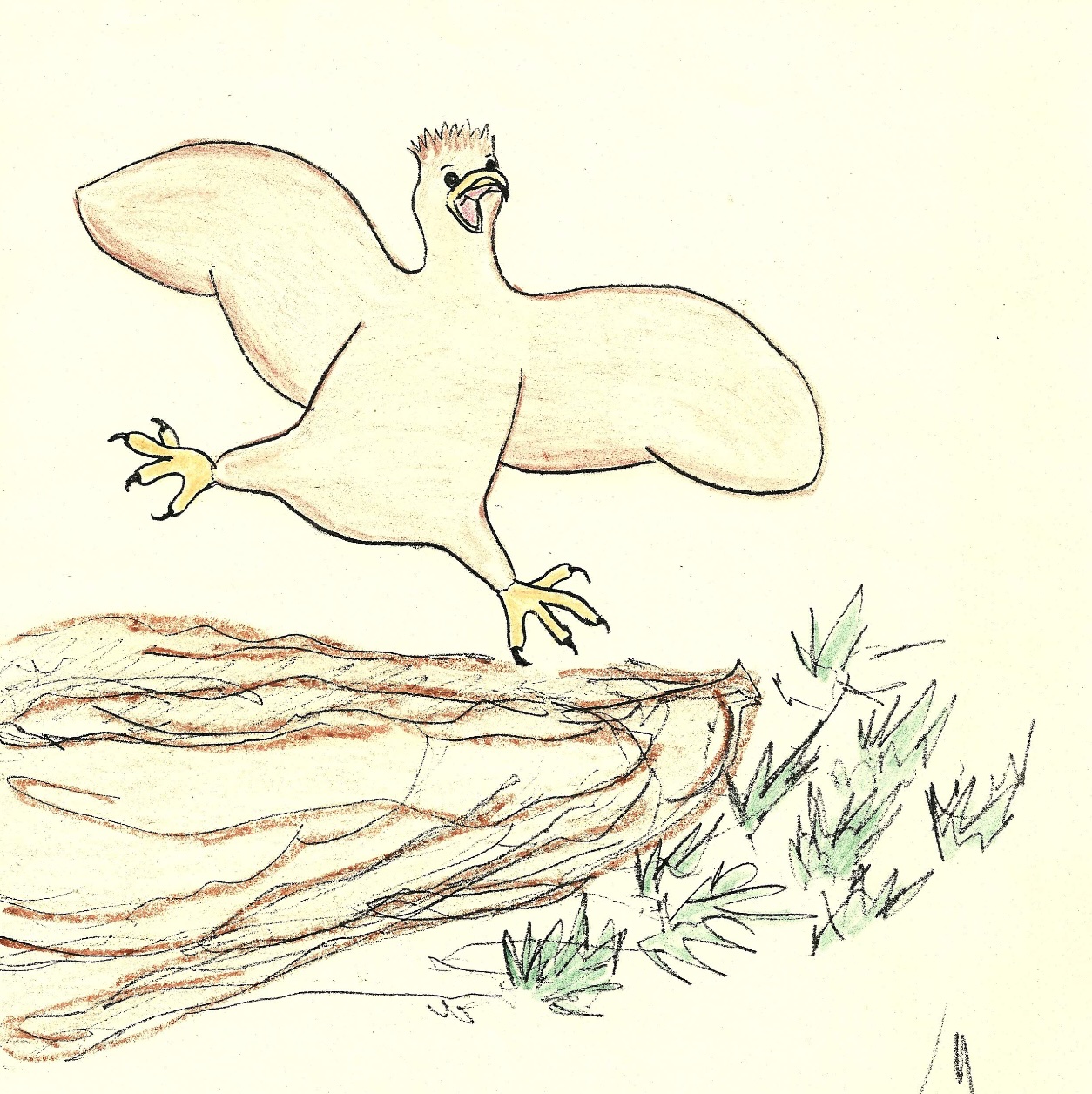
Elly got so excited that she jumped out of the nest without even thinking and hopped over to the edge of the ledge. With one mighty jump, she leaped into the air. For one moment, Elly thought she was flying. Then she realized she was falling.

I thought I could fly

            But this is a fall

            I’ll go SPLAT

            And that will be all!

            HEEEELLLLLPPPP!!!

And Elly fell farther and farther and farther.

Suddenly, Mom appeared out of the clouds. She glided under Elly and caught Elly on her wings. Elly held on tight as Mom soared upwards then landed beside the nest. She told Elly how badly she could have been hurt.

Then she added, “Don’t worry, Elly. One day, you will grow. One day, you will fly.”

And Mom was right. Day after day, Elly practiced stretching her wings. Soon she practiced flying. Day after day, Mom had to catch Elly on her wings. But one day Elly flew on her own. She soared above the tips of the mountains. She glided over tops of trees. She floated over rivers and lakes and streams.

Finally, Elly rested on the soft green grass of a field. She laughed out loud and said:

I’m Elly the Eagle

And I’m gonna fl

I’ll be as high

            As a bug in the sky!

Then she heard a voice. “Silly Elly, bugs aren’t as high as eagles in the sky.”

Elly looked down and saw a little beetle glaring up at her. She wondered why he wouldn’t fly as high as she could. He said he had to stay close to the ground. “That’s just the way things are.”

“No way!” cried Elly. “Just climb on, and I’ll show you—that’s not the way things have to be!”

The beetle was curious, so he climbed onto Elly’s wings. Suddenly both were soaring over the tips of mountains and gliding over the tops of trees.

            I’m Elly the Eagle

            And I can fly—

            Now I’m as high

            As a bug in the sky!

Knowing and Unknowing

There’s a moment

just before sunset

when I think of people I know

who might also think of me

at the end of a day

and remember something sentimental

about moments we shared together

but then I watch the dusk turn to dark

and see the stars appear above me

and think of the unknown they

are existing in trillions of miles away

from this speck in space that I call home

and I think of all the unknowns in life

 and I think of all the unknowns within me

and I wish that people who saw my sorrows

from old scars and new grief also knew my joys

from three-hour conversations with women

who know how to laugh and heal and

sit with their own power to small brunches

with books and family photos shared

and those who knew my joys also

knew how cherished they were

because of the scars I hide from

all who try to draw near

and I wish people knew

how to unknow all about me

that they got wrong when

they interpreted my life

through the lens of their own

experiences while retreating to

their own comfort zones

and I wish they could see

the stars shine on me now

even though some know my faults

better than they ever knew my strengths

and I keep a distance from most people

because of the scars from the ones

who hurt me the most without ever

saying they were sorry

and I let people catch glimpses of me

just as these stars are peeking through

their own places in the night sky

but I let no one close enough to

see what makes me uniquely me

and I let words be my best friends

as a poet does and I share my soul

with the pages before me

and forget that I was

wishing upon a star

that I might be known by some

or forgotten by others

or remembered

with love

or seen

as me

—Chris Pepple c2025

Tell Your Story

Someone asked me once why I liked to write in first person. It’s because the story belongs to the person who lived it. The truth about a life should first be told by the one whose truth it is. Then we may share the story to bring it into the global conversation—to weave it into our communal history. I, as the writer, merely empower the characters to tell their own truths.

From Without a Voice:

first person quote

Redefining Family

The word “family” can stir up wonderful memories for many people. Thoughts of holidays with loved ones, family photos to celebrate one member’s milestones in life, or simple summer afternoons sharing a picnic or a game. That same word, however, brings up a longing in others—a hope to one day reunite with a loved one. A hope that a family member may change and become more loving. A hope to feel loved and connected to others. Some of us often grieve over the word family—grieve for members who have died, grieve for those who face hardships or illnesses, grieve for those who left, grieve for those who hurt us rather than love us.

When “family” is something we lost or must leave, how do move forward? Do we toss out the idea of ever being a part of a family again? Can we redefine what family means to us or redefine who we consider our family?

The characters in Without a Voice faced these questions as they struggled with the emotional challenges of losing family members and leaving family members. Some quotes from the characters give you a glimpse of how they redefined family as they journeyed forward:

“The images of my mother and father seemed like ghosts that I could see but not grasp. I realized that my parents were now just memories. The people before me were my family now. Together we had redefined home with each place we stopped along our way. We never said aloud that we loved each other, but, somehow, we knew the feeling was there.”

“Uncertainty still loomed ahead, but facing the unknown with loved ones seemed more hopeful. Love eases so many fears. Jane reached out and squeezed my hand as if she could read my thoughts. Together would be much better than alone.”

“I smiled at the thought of being a part of this group that had bonded like family. We were strangers thrown together by the sheer coincidence of location on our separate journeys—different needs on the same road.”

If you are part of a book club reading Without a Voice, discuss the theme of family and how the theme evolves throughout the book. If you journal, write down your thoughts of how we redefine family as we face the changes life brings us.

Love Heals

Thistle Farms in Nashville has a quote that they use a lot. “Love heals.” That is such a powerful statement even though it seems so simple. What does that mean? For me, yesterday brought two perfect examples.

First, my best friend in Nashville sent me a beautiful picture for my wall. She became my best friend because we loved each other enough to listen to the life story of the other. We are nothing alike and many times she confesses that my story is so hard for her to understand. She’s happily married-I was married to an abuser who still creates problems in my life. She lives comfortably. I struggle financially because of the past and because of current medical bills for my daughters. The list of our differences goes on. But when I am struggling the most, her “love heals” because she never gives up on me.

Second, when I sent out an announcement about my book, I had someone email back saying she had lost contact with me because she knew of some of the challenges in my life but had no idea what to say. It was awkward for her. But now the conversation is started. She told me what she knew, and I told her what would have helped. Silence hurt. Love heals.

I hope the characters in my novel, Without a Voice, help paint that picture of how love does heal. That includes loving ourselves enough to take the first steps to healing!