Tables or Sides

If you are following my podcast on iTunes or SoundCloud (Look to See Me by Chris Pepple), you can find some of the transcripts of my episodes here.

***

Hi, Listeners! I hope you are all safe tonight and are finding moments of peace and hope in these challenging days. I know we are in the middle of some stressful and uncertain times. I do welcome you, though, to this season of Look to See Me, a podcast that invites you to look closer at the lives of people around you and to take time to hear their stories. I’m Chris Pepple and today I’m going to talk about tables. 

I used to naively believe that there never had to be “sides.” There never had to be choosing who to stand with because I thought we could learn to stand together. I believed in tables…I believed in conversations. I believed in being a lifelong learner and being willing to hear another person’s voice, to understand another person’s life experiences.

For example, I’m not a farmer, but I can come to the table with a farmer and hear their joys and their struggles and grow from that…find ways I can be true to who I am and still find ways to help farmers be successful in their lives. 

I’m not black, but I can come to the table with black men and hear their fears and cry with them over the racism they have faced. I can still be true to who I am and find ways to stop racism, end discrimination and senseless deaths, and help black men fulfill their dreams and raise their families and be successful in their careers. 

I’m not transgender, but I can come to the table with a person who is and hear their life story. I can still be true to who I am and find ways to help them feel safe and loved and respected in this world. I can make their life better so they can find hope and follow their dreams. 

I’m not a child about to age out of the foster care system, but I can come to the table with them and see the struggles they have faced. I can hear their fears and see the worry in their eyes. I can still be true to who I am and help bring changes that will make their future brighter. 

I don’t have to give up any of my dreams to make this happen. My dreams have a place at the table, too. We talk it through at the table. We bring hope and love and respect to the table. We listen to each other and find ways to make a life of hope possible for all people. I was taught that nothing is impossible with God, so this is what I thought could happen. I didn’t want it to be about choosing sides. 

But then life taught me that some people are unwilling to come to the table and listen. They not only refuse to sit with some people, but they try to take the chairs away from the people on the way to the table. 

I first realized this when I faced domestic abuse. There were people who didn’t want to hear or believe me. They judged me harshly, and some still do. They sided with the abuser and took my chair away from the table they sat at. 

Then I saw the members of the LGBTQ community try to come to the table to talk. I first saw this in the 90s during the AIDS crisis. Churches closed their doors. Families cast people out. Too many people refused to sit at the table with a gay person and try to share love and hope in the middle of a tragedy for the world and for our nation. Without a shared table, I had to choose sides. I chose to stand with the LGBTQ community. I led a funeral for a dear cousin who died of AIDS. I presented his square to the AIDS Memorial Quilt. I lost my seat at many tables, but I found much joy and love with the people who were willing to share their table with me. 

Then I met wonderful people who are transgender. I happen to have someone in my family who was accidentally assigned the wrong gender at birth. I learned what nonbinary means and queer and bisexual and pansexual. I came to the table and listened. But then I realized again that too many people refused to come to the table. Our table, instead, was spit upon and cursed at and judged by people who refused to join the conversation. So, I had to choose sides. I chose the table full of love and respect. We help each other dodge the rocks thrown our way. We hug through the tears of rejection. But we find joy and love. 

Then I heard the cries of black men dying from police brutality and from white vigilantes declaring it their right to kill anyone they are suspicious of. I saw black mothers crying. I looked around and realized that again too many people were refusing to come to the table and hear their cries and find ways to stop the deaths and the racism causing them. I had to choose sides. I stood with the people declaring that black lives matter. I chose justice and love and respect for all people. I chose to stand with people who want to live their lives without fear of being killed for no justified reason at all. And I found Jesus standing right there next to me. And I found people praying that I could kneel with and pray. I found people who heard me and who shared their stories and their tables with me. 

I still believe in tables. I believe that we can learn to hear each other and stop declaring that we have to choose sides. Humanity does not have to be divided up into sides. We can come to the tables with respect and love. We can listen. We can stay true to who we are and allow others to be respected for who they are. We can see the beauty in the diversity around the tables. We can learn from the gifts and talents and stories of others. We can share our gifts and talents and stories with them. 

I heard a preacher this past Sunday ask the question, when you use the word “we,” who do you exclude? When you say “we” are joining at the table, who do you refuse to sit with? The transgender teen? The black man? The impoverished single mom? The one on welfare? The domestic abuse survivor? The crying mother? The gay man? The married lesbian couple? The Native American? The Mexican family? The immigrant? Who do you exclude from the table? 

It hurts to lose your seat at the table. We all want to be loved and included. I want to love and include you…all of you…but I tell you this…if you exclude someone, you will force me to choose sides. And if I have to choose sides, I will always get up from your table of privilege and stand with the person you refused to sit with. I will walk with the ones being discriminated against. I will work to stop racism and hate crimes and transphobia and homophobia and bullying of all forms. I will willingly give up my seat at your table of privilege if you are unwilling to listen to the voices of others and respect them. 

Stop making us all choose sides. This is humanity…all of us together…the diversity of skin colors and genders and sexual preferences and gifts and talents and life stories. It’s a beautiful view from my perspective when I picture us all coming to the table for significant conversations that will bring so much love and joy to us all when we work for peace and hope and justice for all people. I will never give up this hope. I no longer regret the times I’ve lost a seat at a table for being true to this hope…for being true to who I am and what I believe and what I stand for…

Come to the table…join the conversations that can be so hard to hear at first…bring love with you and you will be loved in return…there’s laughter and joy on the other side of the tears we will shed when we realize all the unnecessary losses that have occurred when we excluded people from the table. 

Thanks for listening to this episode of my Look To See Me podcast. I love you…you are worthy…you are strong…you are beautiful…never let another person define you…join me at the table, won’t you? 
It Was Me

It Was Me

I am the one that 

was raised to be

part of the problem…

who was raised to stay 

on the white side of the street

and who was raised to label 

everyone in conversations…

“the black family on the street”

“the Muslims one street over”

“the Jews who live in the cove”

“that Indian man who owns the store.”

I learned all the assumed adjectives…

lazy, cheater, thug, thief, 

will steal you blind…

and I learned that people 

hired you for cheap labor

but never appreciated your work…

Then I met you…it was a new world…

you were smarter than me in trig class…

you tutored me, you taught me about life…

you were the coach of my team…

you doctored me back to health…

you befriended me…

you were there when I cried…

you taught me to get back up…

I learned your history and saw

everything wonderful and strong about you…

and I had to live with the fact that I 

never spoke up before now…

I was raised to be part of the problem…

my silence allowed your beatings and death…

the labels stripped you of your seat at the table…

the lies about you took away your hopes and dreams…

And my silence never brought change…

But I promise you now

I will roar for you

and film the wrongdoing

and call out the racism

and name it

and pray for change

and work for change

and be the change

though it will never

bring lost ones back to life

or heal the wounds from beatings

or restore all that you have lost…

but I will lose the labels

offer respect

fight for justice

and never be silent again.

–Chris Pepple ©2020

The Belief Came Tumbling Down

Dear person in the pew, person in the street, person declaring your rights—I hear you. I’m a listener. I want to understand you. You are fighting for a belief—for a right. You are declaring that belief to be key to your religious life. You, however, are not setting your beliefs in stone and building upon them. You, instead, are creating paper towers that tumble when the wind blows. 

You declare that businesses have the right to turn away gay couples who want a wedding cake. You say it’s their right to determine what they are comfortable with in their own business. However, you declare that Whole Foods can’t decide that they are going to require people to wear a mask. You threatened any business that decided their faith told them to care for their employees and customers in this way. 

Your belief just came tumbling down…

You declare that protests should never interfere with traffic when Black Lives Matter groups block cars and walk across a bridge. You say that is interfering with the safety of others and creating a dangerous situation, yet you block roads around a hospital and a state building when you are angry about public policy. 

Your belief just came tumbling down…

You declare that you can protect your own home in a way that seems best to you and declare that you can shoot and kill intruders, yet you have a black man arrested for shooting a gun in the air inside his house when people walk into his home unexpectedly. 

Your belief just came tumbling down… 

You declare that truth should be held up as an ideal in this nation, yet you do not call out lies caught on tape. 

Your belief just came tumbling down…

You declare that life is sacred and should be protected against those who seek an abortion, yet you let children die in our protective custody. You let domestic violence continue to kill women and men and children in this nation. You fight against medical care that would save thousands of lives each year. 

Your belief just came tumbling down…

You declare that sexual purity should be an ideal that we all seek, so you fight against access to birth control and condoms. You, however, let rapists go free. You keep the pornography industry in business. Child sexual abuse is still prevalent in our nation. You say “boys will be boys” when they grope girls against their will. 

Your belief just came tumbling down…

You declare marriage to be sacred and demand that it be exclusively a right given to a man and a woman, yet you have high divorce and adultery rates and don’t question your buddies when they cheat on or abuse their spouses. 

Your belief just came tumbling down…

Your paper foundations that fuel your protests and your anger burn quickly when held up to the light of your actions. The ashes blow away in the wind when your need for comfort and personal satisfaction collides with your declared beliefs. 

What do you believe? How often do you ask yourself if your life reflects what you yell so loudly? Do you really live your beliefs, or do they come tumbling down when your own actions bump up against them?

I believe in the sacred worth of all people…

I believe that love heals and love wins…

I believe that my actions should reflect my faith and should help work towards the greater good—should build a nation where we are all respected.

I believe that all people deserve a chance at health and all should be allowed to join with the love of their lives and find joy…

I believe that gender is more complicated than we knew, and I’m willing to be a lifelong learner…

I’m willing to listen to you and also work to include you in the community…

I believe we can end hunger and abuse and unnecessary deaths if we work together…

I believe we can come together in community and seek truth together, in conversation with each other… 

I believe we can share a common table…grab a chair and have a seat with me…

Let’s pray to God who taught me these beliefs… 

Deeper Conversations

I read the news every morning to stay updated. Two things are still sticking with me. One: more than 40,000 deaths in 49 days. That’s a powerful virus we are up against. That doesn’t count the people left with heart or lung damage or the actor who had a leg amputated after complications from the virus or the thousands still on ventilators or weak at home. 

Then I saw a protestor holding a sign that said, “I need a haircut.” She was yelling for hair salons and barber shops to open. 

We are all weary at this point. Many of us have lost income. We know someone who has been sick. Many know someone who has died and can’t even be honored with a funeral. We don’t know what’s next and don’t have all the answers. 

Another protestor held a sign that said, “Facts over fear.” This I do know as a fact. I don’t “need” a haircut even if I want one. I will give up my financial stability for the life of a person. The death toll is growing. I am called by my faith to give so that others may live. I am called by morality to value life over anything material. 

I don’t want to fail financially. I don’t want to lose my home or have less to eat. I don’t want my kids to do without anything. I don’t want that for any of us. But life is worth sacrificing for. The vulnerable in this society deserve better than sacrificing them for a haircut. 

We can do both things: strive to help create financial stability for everyone and strive to save lives. Ma’am, put down your haircut sign and write, “Let’s work together to find answers.” 

Sir, change your sign to say, “Love over fear.” You are fearing financial loss. Love someone enough to step out of your fear and see their fear of the virus. Let’s all put down fear and dig deep to overcome both fears together. I know the answers are there. It takes all of us coming the table for hard conversations to find the answers.

All That Is Good

If you are following my podcast on iTunes or SoundCloud (Look to See Me by Chris Pepple), you can find some of the transcripts of my episodes here.

***

Hi, Listeners! I hope you are all hanging in there this week. I know we are in the middle of some stressful and uncertain times. I do welcome you, though, to season three of Look to See Me, a podcast that invites you to look closer at the lives of people around you and to take time to hear their stories. I’m Chris Pepple and today I’m going to talk about all that is good. 

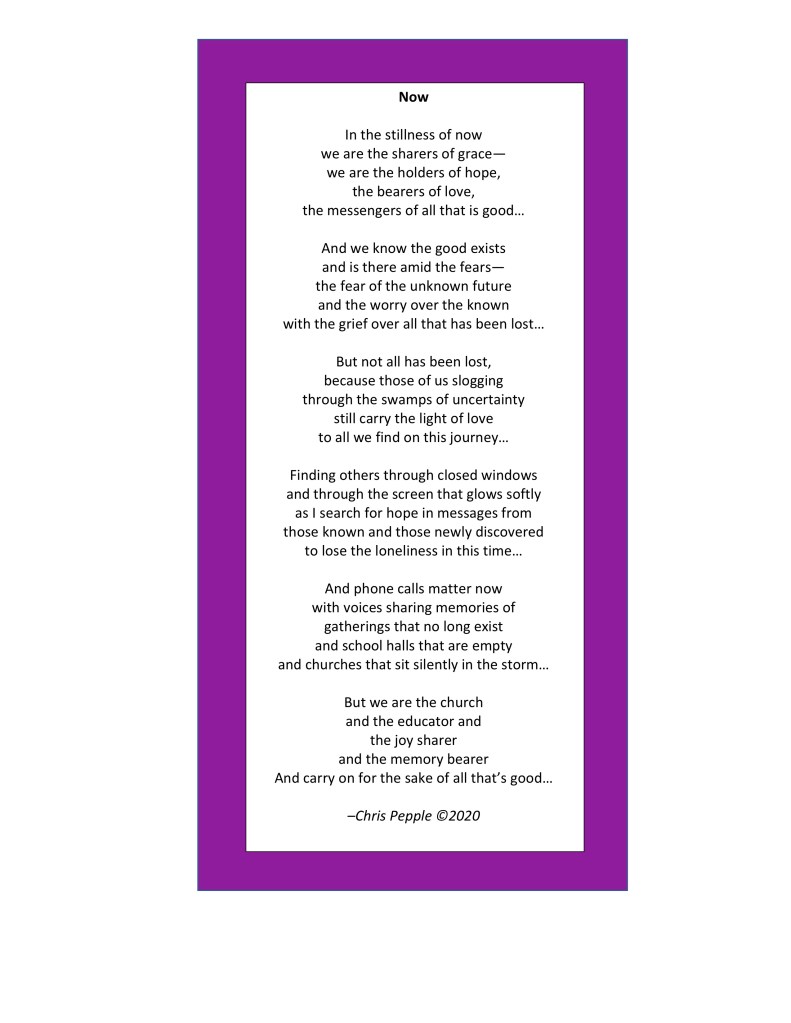
I’m going to start this episode with a poem since April is National Poetry Month. I wrote this poem in March of this year as I was staying with my two young adults trying to figure out how to do college classes from home. There are so many things we are all having to figure out how to do differently. This poem is simply titled Now

I have used this time to do a lot of listening. I have a diverse online friend group and have spent time reading their social media posts and blog posts. I’ve chatted with people through Zoom meetings. I’ve participated in several online church meetings. I’ve realized that I have found a core group of people that I can identify with. We share many of the same general beliefs and think alike on many issues. One of the key reasons that I find joy when I am reading posts or having conversations with these people around the country is that we share a common definition of what is good. 

That seems so obvious if you look at this on the surface only. I mean don’t we like to hang out with people who think the same things are good as we do? But I’m not talking about what food is good or what movies are good or what music is good. That’s just a bonus for me if I’m with people who have similar likes in these areas. Isn’t life fun when we like the same pizza toppings as the person sitting across the table from us? 

But this past month I have been thinking about how people define “all that is good.” I hear people debating if the economy is the goodness that we should strive to protect, if our local or our national governments are representative of all that is good, if our healthcare system defines or protects all that is good. Now here’s where conversations normally break apart and often end. We disagree over one of these topics, or we make these topics and “either-or” choice as if two of these things can’t be good at the same time—we ask people to choose one or the other. 

I am challenged by people often, asking if I am negating the goodness of one group of people when I am affirming another group. It’s not either-or. It’s both. It’s all. I can love and respect one group without negating my love for others or disrespecting others. 

Are any of these listed above really representative of all that is good? 

I have listened to many people and read many books. I read my Bible. I read the writings of many religious leaders—Christian and Jewish and Hindu and Muslim and many others. I have thought long and hard about what I consider to be the good in the world…what I will choose to love and be a voice for as much as I am able. I think we all need to use this time to define what we will stand for and what we define as all that is good in this world.  

For me, the first part of goodness is people. All people. I love the diversity of people I have met over the past few years. For so long, I was in my own little world with very limited interaction with people outside of my circles. And then I found the rest of you…I heard your voices and saw your talents. You taught me to dance to songs I had never heard before. You painted pictures that I could have never imagined. You hugged me and laughed with me. You shared your sorrows with me and together we discovered new joys. I heard others say, “Be careful. You know how ‘those people’ are.” But what’s so funny is that I do know how you are…you are beautiful and strong and courageous and gifted and curious and loving and struggling with many of the same things I struggle with. 

But you are part of all that is good, and I am so blessed that I see that now. I am blessed that I opened my heart and my eyes to see beyond the walls I had previously hidden behind. I am blessed by the diversity of friends I have. 

The next part of goodness for me is community. We are stronger together. We were meant to be in community with each other, sharing laughs and joys and sorrows and hurts. We each have strengths and gifts that make the community stronger. Each of us has something we bring to the table, and each of us is worthy to have a seat at the table. When we exclude others from the table, we break this community and a chance for growth and love for us and the person excluded. 

The next part of goodness that I hang on to is love. Love is what ties people together in community. Love is what keeps us going. Love is what makes us stronger and heals us. Never let someone tell you that you are unworthy to be loved. Walk away from anyone who says that until they can see your beauty and know you are beloved. What they say is not true. You are loved. And you have love inside of you. It’s there even if you have been hurt and can’t feel it right now. It’s there. 

And let’s talk about passion. When I talk about passions, I’m talking about recognizing that which you feel deeply about. I’m talking about the personal gifts and longings inside of us that we can either use to build up only ourselves or that we can use to strengthen both who we are and build up those in our local and global communities. What do you feel passionate about? What insights and gifts do you have that make you feel most alive when you engage them? And how do you use your passions? When you use them for others, that becomes part of all that is good in this world. 

An architect can design both their own castle and a humble home for someone who doesn’t have one. A pilot can fly their own planes only or can also fly a patient to their next treatment site. An accountant can keep their own books and work for business purposes only, or they can donate some time to mentor others in financial matters. Following your passions and using your gifts should be life-enriching to both you and others. That’s part of all that is good in this world. 

Nurture the gifts that you have and use them for good. Let them build you up and bring you joy and let them allow you to share that joy with others. 

And I can’t end this without talking about compassion. Compassion is extending my passion and love to others. Compassion is a true concern for others. If we have compassion, we must be listeners. We must hear the stories of others without listening only through our own life experiences. We must accept that things happen in this world that we have never experienced and have not yet previously understood. But when we deny someone’s story, when we try to deny their truth, we cause a deep harm in them and in our community. We can’t define another person based on our own experiences and beliefs. We can’t deny a life event because we didn’t see it. 

Abuse happens even if we do not see it. Abusers exist even if they seem nice to you. Racism is real. Poverty is real and occurs for many reasons. Homophobia is real. People being beaten because others disagree with them is real. Hunger is real. Child abuse is real. Sexual abuse is real. 

We often don’t want to admit that someone is experiencing any of this, because it’s hard to hear and because then we must admit that our silence played a role in allowing to continue. Compassion is the opposite of silence. Compassion is the opposite of refusing to accept someone’s story. Compassion is the opposite of looking away or of inaction or of not being a part of the solution. 

Let’s all use this time to define what we know is the good in this world. Let’s be part of the good. Let’s love. Let’s be part of the healing and part of the compassion and part of the growth and part of the table building so all can have a seat with us. 

Your challenge this week: write down all that you think is good in this. world. Then look at that list compared to what your personal faith says is good. Look at that list and ask how it lines up with love and compassion and hope. Look at the list and ask how it is life-affirming and life-giving. 

Hang on to all that is good. Now is the time to embrace the good, share the love, offer hope, enable healing, and find joy and love and hope for yourself in the process. 

Thank you for listening to this episode of Look To See Me. I hope you tune in again soon for another episode. Stay safe and stay well. 

Nurses and Their Tradition of Sacrifice

If you are following my podcast on iTunes or SoundCloud (Look to See Me by Chris Pepple), you can find some of the transcripts of my episodes here.

***

Hi, Listeners! I hope you are all hanging in there this week. I know we are in the middle of some stressful and uncertain times. I do welcome you, though, to season three of Look to See Me, a podcast that invites you to look closer at the lives of people around you and to take time to hear their stories. I’m Chris Pepple and today I’m going to talk about nurses. 

I’m recording this during the shelter-at-home mandate in my city during this coronavirus pandemic. I want to use this podcast to thank some of the people who are selflessly working to help bring this crisis to an end and who are working to help ease the suffering of all who are ill at this time. I’m also going to talk about some of the famous nurses in United States history. 

First, let’s look at today’s nurses. During this pandemic, we realize how valuable nurses and doctors are to our society. They sacrifice so much for our well-being. They care for children getting vaccines during well-child check-ups; they care for children dying from cancer. They clean up after sick patients. They take temperature and other vitals at all hours even when we complain about the care. They reassure parents; they try to keep worried families updated. They do all of this while still taking care of themselves and their own families. So, we all owe a debt to all of the caregivers and service workers and doctors and nurses providing hope in this pandemic. I’m just going to highlight a few specific examples of today’s nurses giving back. I’m sure your community could add thousands of examples to this podcast. 

The first shout out I’m going to give is actually to a nursing student who understands what her fellow nurses are facing. As a senior nursing student at LSU Health New Orleans, Kristina Rigterink decided she needed to do something to help nurses on the front lines of the pandemic crisis. She and her mother realized that medical supplies were in short supply across the country. Hundreds of healthcare workers were testing positive for coronavirus because they couldn’t get the masks, gloves, and other items they needed to stay safe while treating others. 

The two women decided to make a difference. They started organizing ways to collect supplies and get them into the hands of people who needed them the most. They gathered unused face masks, disposable gloves and surgical gowns that protect medical workers from catching and spreading the disease. As the word has spread around social media, more people are donating the supplies needed to keep our nurses and other healthcare workers safe. This nursing student stepped up when needed. 

On March 22, New Jersey issued a call for help. They needed nurses to help care for the patients flooding in for help. The New Jersey State Nurses Association answered the call. Their CEO, Judy Schmidt said: “We will do our part to swiftly contain COVID-19 by caring for every patient — no matter the sacrifice.”

Within one day, they had recruited more than 470 additional nurses who had been retired for less than five years. Other states are taking similar measures…nurses who have retired are stepping back into work for the greater good of our citizens. 

Eileen McStay, a registered nurse at the Mount Sinai Hospital in New York City, and many others like her are worried about protecting their families. McStay decided to send her kids to stay with their father during this crisis, and she doesn’t let friends come visit her because she could have possibly been exposed to the virus by patients. She works long shifts, then she goes home to an empty apartment with no one to care for her. It’s a choice that many nurses around the nation are making. 

But nurses have been making sacrifices throughout the history of our nation. Let’s look at some of the nurses who have made a difference in the past. Many of us read about the nurse Clara Barton when we were in school. Her life is certainly worthy to be discussed. Here, though, I want to talk about one of her relatives—her aunt, Martha Ballard. Ballard was born in 1734 and died in 1812. She was an American midwife that also worked as a nurse and herbal healer. She worked for 27 years as a caregiver in a pioneering community in Maine. 

During that time, Ballard delivered 816 babies and treated numerous ailing residents in a time when people often died due to lack of healthcare. What is fascinating about Ballard is that not only did she step up to serve, but she also kept detailed medical records on her patients. Many doctors at the time didn’t even do that. Through her diaries and writings, Ballard still gives us valuable information about the history of medical work in her day. For example, in an August 1787 entry, Ballard writes about traveling from house to house to care for children with scarlet fever, which is a form of a strep infection. While she was serving others, she recorded details about the herbal remedies she used. Thanks to her service, many people survived what could have killed them without care. Thanks to her writings, we have a glimpse at very early medical records from the beginnings of our nation.

Dorothea Dix didn’t start her working life as a nurse. She was first a teacher and an administrator for a private school in New England. During the Civil War, she saw a greater need, however. She volunteered for the Union Army and helped recruit other women to the nursing field. Dix eventually served as the Superintendent of Army Nurses for the Union Army. Dix became known for many things, but three things stand out to me: 

  1. She treated both Union and Confederate soldiers. Dix did not discriminate when it came to helping others. She saw the greater good and worked to help anyone in need. 
  2. She pushed for formal training and more opportunities for women nurses. She saw the valuable role nurses could play in the healthcare field and fought for the training they needed to succeed.
  3. Dix also fought for mental healthcare improvements. She devoted time to advocate for better treatment and care of patients suffering from mental illnesses. She eventually helped found a total of 32 institutions in the United States dedicated solely to the treatment of mental health illnesses.

Just a little aside here…did you know that First Lady Mary Todd Lincoln and poet Walt Whitman also volunteered as nurses during the Civil War. They stepped up in a time of need. Now, I’m mentioning them here because they did much more than just volunteer. Mary Todd Lincoln actually realized the value of the trained professional nurses and pushed for the organization of an actual nursing corps. After visiting his brother who had been wounded, Whitman signed up to be a nurse at the battle zone in Fredericksburg, Virginia, and volunteered in this capacity for three years. Some of his most famous poems are about his time as a nurse. 

Next I want to talk about Mary Seacole. She nursed wounded soldiers during the Crimean War. She actually set up what was known as the “British Hotel” behind the lines during the war. She and Florence Nightingale were working during the same time period. Seacole, born in Jamaica, applied to the War Office to officially work as a nurse during the war. She was turned down, and she (along with historians studying her life) wonder how much of a role racism played since Seacole was a mixed race, born to a Scottish father and a Jamaican mother. 

Being turned down didn’t stop her at all. She used her own resources to open a facility to nurse wounded officers and servicemen. She was posthumously awarded the Jamaican Order of Merit in 1991. In 2004 she was voted the greatest black Briton. Her autobiography, Wonderful Adventures of Mrs. Seacole in Many Lands (1857), is one of the earliest autobiographies of a mixed-race woman, and it details her work as a nurse and her challenges in working to overcome racism in this field.  

So, nurses have a long history of stepping up in times of need. They have worked tirelessly to ease suffering, help heal the sick, and mend the wounds of both soldiers and civilians. They have left a legacy of heroism and determination and self-sacrificing work. 

Our challenge for the week: thank a nurse. Mail a card. Send a text. Call in an order to a local restaurant and have food delivered to their home. Remember that there are people in the world that work without much recognition. If you are a nurse, I thank you for all of your work. I pray that you all stay well during this pandemic and that your families stay safe. Hang in there, nurses. Know that we appreciate all that you do! I’m doing my part and am following the requests for people to stay at home. My kids are taking their college classes from home, and I am working from home. 

Thank you for listening to this episode of Look To See Me. I hope you tune in again soon for another episode. Stay safe and stay well. 

Today…Together

If you are following my podcast on iTunes or SoundCloud (Look to See Me by Chris Pepple), you can find some of the transcripts of my episodes here.

***

Today…Together

Hi, Listeners! I hope you are all hanging in there this week. I know we are in the middle of some stressful and uncertain times. I do welcome you, though, to season three of Look to See Me, a podcast that invites you to look closer at the lives of people around you and to take time to hear their stories. I’m Chris Pepple and today I’m going to talk about people making one right choice at a time today. There’s a quote from Frozen 2 that says, “When one can see no future, all one can do is the next right thing.”

The next right thing. As I am keeping my social distance from everyone as we all face this pandemic together, I am staying informed by following a variety of news sites. There are so many governors and mayors and CEOs and school boards and nonprofit leaders that are having to decide each day what the next right thing is. A Colorado educator summed up our choices well when he discussed closing schools: “It is important for our community to remember that these measures were enacted out of an abundance of caution and to help prevent the spread of COVID-19,” West Grand Superintendent Darrin Peppard added. “We did not enter into this decision lightly. In the end, it will be impossible to know if we overreacted or did too much, but it will be quite apparent if we under reacted or did too little.”

We are left without a road map in these times and are having to learn from each other and from others around the world facing this challenge. We are looking to doctors and scientists and researchers to guide us. We are even turning to history to see what we can learn from past pandemics. I read an article about Philadelphia leaders choosing not to cancel a parade in 1918 when the Spanish flu was making its way through the country. Within 72 hours of the parade, every bed in Philadelphia’s 31 hospitals was filled and eventually 2,600 people died in the city from flu complications. This was much higher than the death rates in other cities who canceled large public events and put restrictions in place for gathering. 

So, I’m thankful that we have so many people trying to decide what the next right thing to do is. Another thing I am thankful for: I keep seeing social media posts that are so uplifting. In these hard times, people are trying to decide what the next right thing to do is. It’s so easy to only think of ourselves…think of what our immediate needs are. We make our lists and head out to stores before everything is gone. We plan ahead for what could be weeks of staying in. 

Don’t get me wrong. Self-care is important. We have to stay strong and healthy so we can help care for our families and for others who may need us. If we become weak because we haven’t eaten, then we certainly can’t help anyone else. But there’s something beautiful about only taking enough and not taking so much that you take away from someone else. 

And there’s something beautiful about the people who look up from their own lists…who look past their current worries and fears…who look into the eyes of others and see their needs and their worries. In this podcast, I’m going to talk about today…I’m going to talk about what each of us can do in the moment we are in to not only help others but to also bring joy to ourselves as we do it. I’m part of a Mama Bear group, and we always remind ourselves that we are better together. We are stronger when we work together and stand together and get through a crisis together. 

There are some organizations making wonderful choices to give people options for entertainment. 

  • The Metropolitan Opera will be streaming productions at no charge while they are closed.
  • Scholastic has set up a learn-from-home website.
  • Drive-in theaters are opening for people to watch movies from their cars with their families. 

In this podcast, I want to talk about some wonderful things that individuals and communities are doing to think outside of their own worries and work to help others. 

*According to the EdinburghLive Daily News, a convenience store in Edinburgh has been giving away “coronavirus packs” to the elderly for free. The packs contain a roll of toilet paper, handwash, a package of pocket tissues, and a packet of Acetaminophen. Local residents over the age of 65 could pick up a packet. Some staff members even delivered packages to those residents who couldn’t get to the store. Their kindness has been appreciated and is hopefully inspiring others to do the same.

*When an older couple in Oregon needed groceries, they decided that they would drive to the local Safeway and pick up a few items. When they arrived, however, they were worried about being exposed to coronavirus. They waited in their car for 45 minutes until they spotted a young woman, professional runner Rebecca Mehra. They cracked their window and asked her for assistance. The couple, in their 80s, explained that they had no family in town to assist, but they needed a few essentials. They handed Mehra a 100-dollar bill and asked her to shop for them. She agreed and came back to the car with their groceries and their change. When Mehra’s story went viral, she commented that helping was the right thing to do. 

*When the NBA suspended its season, Cleveland Cavaliers player Kevin Love donated $100,000 to help support the team arena’s hourly arena employees after NBA games were suspended. He knew that people losing work because of shutdowns would be vulnerable during this time. He inspires all of us to think of others who may be struggling financially. 

*Elementary students at St. Anthony’s in Columbus, Nebraska, made cards for people in quarantine in their area. The teachers and students understood that isolation is lonely and can increase anxiety and worries for some people. We all need to know that we are remembered. 

*When coronavirus concerns cancelled their daughter’s bat mitzvah party, the Shmidman family turned the food into meal deliveries for people in quarantine in their New York area.The food for the event was already prepared, so the Shmidman family told the caterers to package it up for delivery. Volunteers safely delivered it to those in need. We can all find ways to avoid contact, but still do what is right. They delivered about 150 boxes of food. 

*Local Jewish communities in New York sent care packages to Yeshiva University students in quarantine after a student tested positive for coronavirus. The packages contained snacks and challah and grape juice for use on the Sabbath for students stuck in the dorms.

*People around the world are making personal phone calls. Seems easy enough, but we often forget how comforting it can be to be remembered and to hear a voice. The calls don’t have to be long to be meaningful. Call an elderly person who may not have seen anyone in days. Call someone who is a caregiver and touch base. Read a book over the phone or Facetime to kids to give the parents a break for a few minutes. Small deeds can have a great effect. 

*Order groceries to be sent to someone who may be struggling financially or who may just need treats to brighten their day. Many local stores are delivering to homes for a small fee to cover their expenses. People are picking up on the idea of sending food to others to make a difference in their communities. It helps keep the stores open, and it keeps people out of large groups at the same time. 

*Know someone who lost paychecks? Call their local utility company and make a payment on their account. Pay their phone or light bill. Many local congregations are using this as an outreach tool as a way to keep serving others while social distancing. 

*Give away what you have stored as extra. Jennifer Le gave out face masks to people who had to be out in Singapore. A woman in a grocery store gave an elderly woman some of the toilet paper she just bought. 

There are many things we can do to get through this pandemic together. We can make our communities healthier and stronger by serving others as we also care for ourselves. We can do both well. Your challenge: find the next right thing for you to do. 

Thanks for listening. I hope you enjoyed this episode of my Look to See Me podcast and will return for the next episode.

Stay-at-Home Activities For Adults and Kids

This post will be a little outside of the norm for me. However, I wanted to share some fun websites that we used when I homeschooled my kids. I will also add a couple of podcast links. I hope some of these will help us all stay positive while we are in our homes waiting for the pandemic to pass. Remember what I always say in my podcast: be a lifelong learner. Find some ways to learn something new, read something you may not have normally read, or explore a subject you don’t remember much about from school.

Websites for All Ages

  • The PBS Learning Media site has a lot of pages to explore. They offer something for a variety of ages.  Click here to explore their site.
  • I love the Smithsonian site. Click here to explore their pages. The Smithsonian Learning Lab is also a fun site to explore.
  • STEM Rising, created by the Department of Energy, has sections for students, teachers, and the general public. “STEM Rising is our initiative to inspire, educate, and spark an upwards trajectory to lifelong success in STEM through sharing the Department’s National Labs, National Nuclear Security Administration, and program office’s programs, resources, competitions, events, internship opportunities and more.” Click here to view their site.
  • The US Patent and Trademark Office also has a fun site that contains information for a variety of ages, including adults. Begin here to learn about what they have to offer.
  • Want to take your thoughts even higher? Explore Space.com and skywatch or catch up with NASA through some new videos.
  • National Geographics educational pages bring excitement into a classroom or home.
  • I also enjoy the Biokids website. This site, run by the University of Michigan, lets you explore many species and have fun at the same time.
  • Tennessee Valley Authority (TVA) also has information and games to help us learn and have fun. This site is geared toward children, but it is fun to explore with them.
  • Indigenous Mexico is a website that shares the research of John P. Schmal. Schmal is a historian and genealogist who specializes in the genealogical research and Indigenous history of many of the Mexican states.
  • The Metropolitan Opera will be streaming productions at no charge while they are closed.
  • NASA offers several online image galleries.
  • Digital History is a fascinating site that contains primary sources on United States, Mexican American, and Native American history, and slavery; and essays on the history of ethnicity and immigration, film, private life, and science and technology. These are just a few of the options for you to explore.
  • Do History is a site that helps you piece together the past by looking at fragments that have survived. The site was created by the Film Study Center at Harvard University.
  • The San Diego Zoo has a really fun website to explore. It’s great for young kids and for older ones.
  • You can take a virtual tour of Yellowstone National Park.
  • You can also take a virtual tour of the Great Wall of China.
  • Chrome Music Lab is a website that makes learning music more accessible through fun, hands-on experiments.
  • Cleveland Inner City Ballet is launching a free Virtual Online Ballet Instruction Program.

Websites for Younger Children

  • Scholastic has set up a learn-from-home website.
  • PBS Kids has a variety of games and learning activities.
  • Starfall has a variety of activities for kindergarten through third grade.
  • Squiggle Park has a section for 3 to eight-year-olds and a section for ages nine to 15.
  • Prodigy motivates 1st to 8th grade students to learn and practice math.

Museums with Online Galleries

(not a complete list)

Fun Podcasts for Lifelong Learners

(And All Who Like a Good Story)

Look to See Me

Stuff You Missed in History Class

Wow in the World

Stuff You Should Know

Brains On

Storynory (Stories for kids, but fun for anyone)

Some Interesting Book Lists to Consider

Have fun, lifelong learners! Stay calm and stay positive.

Today’s Historians

If you are following my podcast on iTunes or SoundCloud (Look to See Me by Chris Pepple), you can find some of the transcripts of my episodes here.

***

Hi, Listeners! I hope you are all having a wonderful week this week. Welcome to season three of Look to See Me, a podcast that invites you to look closer at the lives of people around you and to take time to hear their stories. I’m Chris Pepple and today I’m going to talk about the role historians play in whose stories we are hearing and which people we are seeing.

I love to study history. It was always one of my favorite subjects in school. As I look back now, though, on the things about history I was taught in school, I see that my education was missing quite a bit of information. Now, I know it’s true that teachers only have a certain amount of time each year to teach each subject. There’s no way to cover any era in history with much depth at all. History teachers are wonderful, and they do a great job writing out lesson plans and bringing those lessons to life for their students.

There’s so much the rest of us can do outside of the classroom, though, to make sure that we are still being life-long learners and reading about our past…uncovering truths that may have been buried for generations. Gerda Lerner, the historian who pioneered the field of women’s history, had a valid point when she said, “In my courses, the teachers told me about a world in which ostensibly one-half the human race is doing everything significant and the other half doesn’t exist.”  It’s time to look to see the people from the past that still have something to teach us about the present.

I am thankful that we are in a time of reclaiming more stories from the past and correcting some of that stories that were based more on myth than on truth. I know that there are so many more stories I need to hear. This podcast talks about hearing the stories of those around us. The past two seasons have discussed leaders and organizations that are telling the stories of people whose voices aren’t always heard. We need community leaders and nonprofit groups to walk with people who are journeying on a path that others of us may not have walked along. We need to take a closer look at the work being done to bring hope and healing and love to all people in our communities.

Today I’m focusing on historians, however, because they are working to help us remember the people who walked these paths before we did. They are uncovering stories of people that have brought hope and healing and innovative ideas to our communities in the past and paved the way for us to do so today. Historians are reminding us that people can make a difference and bring about so much good in the world. These stories being brought to light by today’s historians help me better understand the stories of the people around me…the diverse people who make up my community—my local community and my global community. They weave all of us together through a foundation of hope and courage and perseverance that we may have never known we shared.

So, who are some of today’s historians that are teaching us so much through the stories they are unearthing and reviving for us? First, I want to talk about two of my favorite podcasters: Tracy V. Wilson and Holly Frey. Some of you may recognize these names; they are the cohosts of the popular podcast titled Stuff You Missed in History Class. This is a twice-weekly podcast that takes a look at historical figures with new perspectives. The co-hosts don’t just give us a quick glance at the life of a politician, inventor, writer, or other known personality. They dig much deeper to let us know what happened behind the scenes and often out of the public eye. They share old family letters and memoirs written by known friends. They dig deep into the works of other historians and researchers. They do a good job of telling us what information is probably just a gossipy rumor and what might be a fact. We get past the myths and find out what motivated people and what hurts they overcame to achieve their goals. We also find out who really should get credit for work that we attributed to another person. Their podcasts make history fun for me. They cover every topic from fashion design to medicine to shipwrecks. Listen and find out what you missed in history class.

I’ve also recently found a website that has been fun to explore. Indigenous Mexico is a website that shares the research of John P. Schmal. Schmal is a historian and genealogist who specializes in the genealogical research and Indigenous history of many of the Mexican states. He has written several books on the topic and has served on the board of the Society of Hispanic Historical Ancestral Research. Through Schmal’s research, we come to understand the stories that form the foundation for each Mexican state. When we understand the past, we can see the present with new eyes.

Why am I interested in all of this history? Well, can you imagine if a person who knew nothing about you or your past tried to understand your life and make decisions that affected you without knowing anything at all? A doctor needs your medical history to treat you. A counselor needs your history to help find a healing path for you if you are struggling with grief or stress. A psychologist or psychiatrist needs to know in-depth details about your life to properly diagnosis you. A spiritual mentor understands you better once you have talked about your past spiritual journey. Our past has helped shape us and has brought us to our present place on our journey. Our past doesn’t define us or limit our possibilities. We can all overcome quite a lot from our past once we acknowledge it and learn from it. That’s no different from a nation or a cultural group. Past challenges have altered the journey for some people. If we understand that, we can come to see the strengths that people have leaned on to face those challenges. We can see the courage and determination in people. We can see the gifts that all people bring to the table.

Here’s another historian’s name that I’m going to toss out: Clara Sue Kidwell. Kidwell is an academic scholar, historian, and Native American author who is of White Earth Chippewa and Choctaw descent. Kidwell has been instrumental in developing American Indian historical studies programs. She has taught at Haskell Indian Nations University, University of California at Berkeley, Dartmouth College, and University of Oklahoma. In 2007, she started the American Indian Center at the University of North Carolina. She is credited with increasing the visibility of Native American history on college campuses and across our nation. Historians like Kidwell fill in the gaps of our understanding and dispel myths that we often taught as truths.

I could toss out many other names in this podcast. Elizabeth Fenn researches the early American West, focusing on epidemic disease, Native American, and environmental history. Allan Berube, an American activist and historian, is best remembered for his groundbreaking work of gay history. He published an award-winning book in 1990 titled Coming Out Under Fire: The History of Gay Men and Women in World War II. Marie-Josèphe Bonnet is a French specialist in the history of women, history of art, and history of lesbians. Bonnet has written several books and articles about the theme of art, women artists, and the representation of women in art. Vincent Gordon Harding, who passed away in 2014, was a social activist, historian, and a scholar of various topics with a focus on American religion and society. He was one of the chroniclers of the civil rights movement and was perhaps best known for his work with and writings about Dr. Martin Luther King, Jr., whom Harding knew personally.

These historians, and many others who work in their field, know that we all still have so much to learn from the people who lived before us…people who dreamed and toiled and hoped and loved and fought. Historians bring the hopes and the visions of all who walked this earth before us back into the light so we can learn from their work and build on their dreams.

Your challenge for the week: learn about two people who are no longer living. Choose these two people from sources that you have never used before and choose from a group of people that are outside of your own identity. Be a life-long learner and expand who you have been learning about.

Thanks for listening. I hope you enjoyed this episode of my Look to See Me podcast and will return for the next episode.