Shifting the Bowl

I write this story in 2006 after watching friends face losses in their families and after I faced losses in my own life. Grief comes to each of us in so many different ways. Sometimes the grief is hard to process immediately because of the shock of the death or because we face challenges in handling the financial affairs of the family member or the details in planning a memorial service. Often we are also trying to “hold it together” so we can let other families members lean on us in their grief. Once we have begun to recognize and process our grief, however, some memories come to us with sweet reminders of the person. We can remember them without the depth of pain that we once felt we were drowning in. We may still be hit with those waves of grief from time to time throughout life, but we can also cherish the sweet memories that stay with us and remind us of the joyful moments we spent with our friends or family members in the past. This was originally published in my first book of short stories, Look to See Me: A Collection of Reflections.

“Shifting the Bowl”

A Short Story by Chris Pepple ©2006

         I shifted the bowl on my coffee table so I could dust and get ready for the evening.  Six couples from my husband’s new firm were coming by for dessert and I knew they would come down and watch TV.  I had three hours left to get the pies ready and eat a light dinner. Really that was plenty of time, but I felt frustrated by the way the afternoon was going.  I always put so much pressure on myself to get things perfect.  Plus, I really wasn’t thrilled with the idea of having company. 

            Daniel wasn’t thinking the way I think when he invited them over. I thought we still needed to finish unpacking boxes and hanging pictures before we even thought of entertaining anyone. But he seemed excited about the idea, so I went along. I know he wants to make a good impression on his new co-workers and their families. I also know that he was both nervous and excited about this move for us, so he considered guests a good way for us both to feel a part of this place. He felt a little guilty about taking me away from so many friends, so inviting some women into the home gave him hope that I would bond with one or two of them.

            I swished my dust rag across the table and knocked over the bowl and the golf magazines beside it.  Maybe I should just put this bowl away or find a place for it in the guest bedroom.  It didn’t seem to go with the décor of an entertainment room.  I desperately needed to work on the color scheme in the room. I headed upstairs with the bowl, but I had to stop and answer the phone on the way.  I grabbed the cordless and kept walking.

            “Hey, Dad.  How’s your day going?” I asked as I grabbed a couple of towels to take up with me.  I enjoyed chatting with my father on most days, so I thought his call would be a nice accompaniment to my chores. I stopped in the middle of the staircase when I realized he was crying, however.  “Dad, what is it?” I asked even though I didn’t feel prepared to know. If he was crying, the news must be hard to handle. My father was the rock in our family. He held me when I cried, but he rarely cried in front of me.

            “Your Mom’s here at the hospital.  I had to call the ambulance.  I just didn’t know what else to do. I’ve never seen her like this. She…” his voice drifted away for a moment. “Oh, the doctor’s here.  Wait, your brother just walked in, too.  I’ll have him call you back. Pray, Sweetheart.”

            Before I could respond, I heard a dial tone. I couldn’t move from my spot on the stairs.  I needed more information. I needed him back on the line with details. I needed him to say, “I’m sure she will be fine.” More than anything I needed to hear my mother’s voice. I wanted her to tell me she would be fine. I sat on the steps and breathed deeply as I hugged the bowl and towels close to me. My prayers for my mother flowed through me with each breath, prayers for her healing, for her comfort and for her voice to be on the line with the next call.

            I wondered what to do next.  I tried to call Daniel at the office, but the receptionist said he had gone to a meeting. He didn’t answer his cell, so I left a message for him to call back.  In frustration, I dialed my brother’s cell phone. No answer there either. I shouldn’t have even tried when he was talking to the doctor, but I felt helpless in the moment.

             I knew Ben would call me soon. My brother carried the same strength as my father. He would assess the situation, and then he would call me with his formal big brother voice to let me know that he was handling the details. After a few minutes on the phone, his tone would change to let me know he was my protective big brother who would help make things better and would keep me updated. Before we ended the call, he would say something ridiculously funny to make me smile and put me at ease.

            No need to start driving to Vicksburg until he called to let me know if Mom and Dad needed me there.  I should be wise and just stay put until I had news. After all, there was no need for panic. Maybe Mom’s problem was just a mild reaction to her new medicine. Or maybe Dad just overreacted. He usually didn’t, but then again he could be really overprotective of Mom at times, especially as they had aged.  My Dad never wavered in his love for my mother and for all of us in his family. He could have been worried about her and wanted to have her checked rather than let a pain or a minor problem blossom into something bigger.

            An incoming reminder on my cell phone brought my mind back to my tasks at hand. I finally forced myself to continue up the stairs as I waited for my brother’s call. At the top of the staircase, I paused at my desk to check my cell phone to see if anyone had called on that.  While I waited for either phone to ring, I pretended to try to find the perfect spot for the bowl, but tears flooded my eyes.  I had to weep at the sound of hearing my father weep. I had to weep at the thought of my mother being seriously ill.  Logically, I knew my parents were older and not in the best of health, but emotionally I still felt as attached to them as I did during my childhood days when we spent every Saturday evening together playing games and then preparing for Sunday worship. I wasn’t ready to picture them any other way. 

            I went to my room and set the bowl on my nightstand. As I looked at it, I could picture my mother’s hands holding it.  She carried that bowl to our kitchen table many times. Mom used it as a fruit bowl.  That memory brought her voice flooding back through my mind.

            “Beth, come in here and set the table!” she would call to me as I tried to sneak out the back door to see if any of my friends were coming up the sidewalk.  “Beth, get back in here, Dear. You know dinner will be ready soon. I could use a hand for a minute.” My mother should not have had to ask for my help as much as she did. Instead, I should have been more of a willing volunteer. But through my pre-teen and teen years, I thought I had so much more important things to do. I wanted to be like Mary Alice Walker who had the newest clothes, the ones I had only seen in magazines that hadn’t made their way to our smaller stores. And she had much more freedom than I did. I envied her walking through the neighborhood to socialize as she pleased. Her mother hired people to help with meals. I was obligated to help with ours.

            I remember walking into the kitchen noticing that Mom had the bowl full of fresh apples and oranges each evening.  She kept two bananas stretched around each side. They were never browning or overly ripe as mine in our home often are. Mom arranged the bowl as carefully as someone else would a centerpiece of flowers. She could always turn the simple into something beautiful.

            If I tried to reach for an apple before the meal was served, Mom would laugh as she swatted my hand.  “I know tuna isn’t your favorite, but your Dad loves it, and you are not going to ruin your dinner with an apple, young lady.”  Mom knew that I dreaded tuna night in our house. Whenever I smelled it cooking, I tried every excuse not to eat it. I knew that Mary Alice Walked would never eat a meal that consisted of tuna.

            “Will you call your father and your brothers in for dinner?” my mother would always ask. If he was home, my father was always easy to find. He relaxed in his chair each evening when he got in from work. Sometimes he watched television. Other times, he read his favorite books. I could tell he had had a hard day at work if I came to get him and found him asleep. If he was napping in his chair, I wouldn’t wake him until I found my brothers.

            Ben was the second easiest to find. He would be in his room studying. He knew he wanted to be a veterinarian and knew he needed to get a scholarship to accomplish that goal. He kept his nose in a book and his mind focused on the subject before him. When I knocked on his door each evening, he would always answer, “Thanks for telling me. I’ll be down as soon as I finish this one page.” He never actually came until Dad called up to him to tell him he was holding up our prayer before the meal.

            Austin was harder to find. I usually had to go outside to track him down unless Mom found out he had a test and was making him study in his room. He did his best, however, to keep her from finding out when assignments were due and tests were scheduled. To find him when he was out of the house, I just had to listen for voices in the neighborhood. If guys were yelling about a great throw or a good catch, Austin would be there. He played both football and baseball well. If no talk of sports could be heard, then I had to listen for girls chattering about upcoming dances or parties. There I could find the boys leaning over a fence eyeing the girls and daydreaming about who would be dancing with whom. Of course, none of the guys had the nerve to actually ask any of the girls to dance. But my brother and his friends sure looked cool leaning back on the fence and grinning as if they were the Fonz himself.

            Once I rounded everybody up and we gathered at the table, we all prayed and then listened to Dad tell about his day as we ate.  I loved his tales of who did what in town. As sheriff, Dad knew everybody.  He never revealed personal secrets—things he learned on late night calls to houses where the families would be gossiped about the next morning—but Dad sure could tell about interesting things that happened throughout the day. After dinner, Dad grabbed a banana for his dessert. I grabbed an apple to keep from starving since I hid most of my tuna under half of my roll.  I helped Mom clear the table of everything except the wooden bowl.  That stayed there until the fruit was gone. Then Mom would shift it to the counter until she could refill it. 

            I can still remember my grandmother using the bowl, too. She mixed her biscuit dough in it.  As a young child, when I stayed at her house I loved waking up to the smell of breakfast cooking. I always snuggled under the quilt she had made, and I stayed there until she called me. Then I would quickly slip on my clothes and head to her kitchen.  By the time I got there, the bacon and eggs would be cooking.  The biscuit dough would be mixed, and I would help her roll it out and cut the circles using an old jelly jar.  I set the table while they cooked. We ate them with the fresh molasses that the neighbors always sent over.  My grandfather would head off to work after breakfast. My grandmother and I would clean the kitchen. 

            As we cleaned, my grandmother told me stories of her life growing up on a farm. I enjoyed the tales of her early childhood. She knew how to make the dough for bread by the time she was five. By age seven, she helped regularly in the garden. She pulled weeds and planted seeds. She dug for potatoes and picked beans, crawled around for red strawberries and reached high for plump figs. She rode to school on the back of her brother’s horse, holding a warm potato in the winter to keep warm.

Her mother sang to the family every morning while breakfast was cooking and morning chores were being completed. In the evenings, her father read to the family from books borrowed from the small library donated by a former teacher who passed away without any living relatives. The current teacher built bookcases in the back of the school to hold the collection of classics in American and world literature.

            My grandmother claims to have rarely gotten in trouble, remembering herself as a quiet child. Her brother, however, remembers one time when she angered their mother and was punished by their father. One day she saw a bird struggling to build a nest. She watched as it flew from place to place gathering twigs and bits of fluff from plants. The bird even found an old string tossed by her father when mending a broom for her mother.

My grandmother felt sorry for the birds once she realized how hard they had to work to prepare even the simplest of homes. She snuck into the house and made her way to the kitchen. She hoped to find old rags to cut and leave for the birds to line their nests with. As she moved through the kitchen, however, she spotted perfectly designed nests already built and ready to be lined. She had spotted her mother’s wooden bowls.

            My grandmother’s tender heart for animals gave her no option. She had to use at least some of the bowls for the poor birds struggling to make homes. She grabbed two and headed straight for the tree by the back fence. She could climb on the rails and reach the lower branches just enough to secure the bowls in place. She added the shreds of a dishtowel she cut with her father’s hunting knife left on the back porch. She felt pleased with her accomplishment until her mother began trying to prepare for the next meal. After searching the house, she called each child in for questioning. Needless to say, my grandmother was not a good liar. She turned herself in, retrieved the bowls, and accepted her punishment.

            I can still her telling me that as we ate together before washing the breakfast dishes. After she washed the wooden bowl after our meal, my grandmother would put it back on the counter.  Later in the morning, I would find my grandmother kneading dough in the bowl before leaving it to rise for bread for dinner.  I would find a smaller bowl and pretend to knead my own dough and get it ready for a meal with my dolls.  But no other bowl I used during my lifetime seemed to hold as many memories as this wooden bowl I now held. 

            My mother gave me this bowl when we moved into our new house last month.  She knew that bowl held a lot of memories, and she wanted me to have it.  Now I wondered if she knew that her time with me was short.  Did she know this day was coming when memories would be all I had to hold on to? 

            The ringing of my phone pulled me back to the present.  “Ben, how’s Mom?” I asked.  He told me that she had suffered a pretty serious heart attack.  She was hanging on, but I needed to come.  I rang Daniel and he answered this time.  He told me not to leave until he got home so he could drive me down.  I reminded him to tell someone to spread the word around so no one would show up at our house tonight. 

            I was ready when he came to pick me up.  I had packed a bag in case we needed to stay a couple of days.  I rang my daughter and told her what was going on.  I wanted to hug her right then, but I knew I had to head to Mom instead. 

            As we drove to Vicksburg, I prayed along the way.  I also let memories of Mom wash over me.  I dozed for a moment then heard my cell phone ring.  It was my daughter just checking with me.  She had gone by the house just to be there.  She said she didn’t feel much like being in the dorm right then. I knew she would put in a movie and stay up waiting to hear back from me.  If she found the wooden bowl, she would probably fill it with popcorn, salted and lightly buttered just the way we both liked it.

            One day it would be hers. I could picture her hands holding the bowl and talking with her own children. Maybe when they picked it up, they would feel my grandmother’s and my mother’s hands touching theirs for just one moment. I kept that thought with me as I caressed my mother’s hands in the hospital and tried to find a way to begin to say good-bye. How could it be her time to leave this earth already? I felt unprepared for my journey in life to continue without her voice and her physical presence as part of my routine.            

            The time came without my permission. The day after my mother’s funeral, I shifted the wooden bowl to the center of my kitchen table.  I filled it with freshly baked blueberry muffins. I needed to stay busy using my hands in the kitchen. When I saw the bowl, I saw my mother’s and my grandmother’s hands reaching out to me with love. I smiled as my son grabbed a muffin and whisked by me on his way to catch a movie with friends.  A new memory for an old wooden bowl. 

The March of Love and Hope

ON COURAGE AND LOVE—

MAGGIE’S VOICE

             Every Sunday the same group of women gathers in a small apartment on the ground floor of the complex to worship. Every Sunday they sing the same hymns.  Every Sunday they whisper the same prayer:

                        God feed our children—for they are hungry

                        God keep them safe—these times are rough

                        God give us strength on this journey—for we are tired

                        God keep us safe—these times are rough.

The worship service is a chance for these women to rest from the struggles of the week—a chance for them to be touched by a moment of peace.

            The worship service is especially important for Maggie.  Ever since she organized this women’s group, she has been under constant pressure. She’s recognized as “the woman who started all of this trouble.” Last week she had a rock thrown through her window. The week before that her youngest child had a bottle thrown at him on his way home from school. But Maggie is determined not to give up her fight.

            Today Maggie kneels by the board that the women use as an altar.  Her mind envisions what this world could be like. She imagines a time when no more children would die in the streets. She imagines a time when all people are treated with reverent respect. She ponders on what the world would be like if every day wasn’t a struggle for survival for so many people. But her mind is brought back to the realities of the moment by a call from one of the women.

            “Maggie, a newspaper reporter is here. Says he wants to do a story on you and that march you have planned on Sunday. He says you are really gonna stir up things if you really march all of the neighborhood kids into those churches on the north side of town.  He wants to be the first to interview you and print your story. “

            Maggie turned and answered them, “The time has come for a new world to be created.  It’s time for all that we see around us to fall to the ground.  And out of its remains our new world will bloom. And this new world will hold us all in a cradle of peace and love and wholeness.

            But for now, I am worried.  Should I tell God that I am tired of this journey that I began?  Should I call to the angels and tell them that I am turning away from our plans?”

            Maggie was interrupted by a voice from outside.  “Momma, look at me—I can do a cartwheel.”  And all of the children giggled. 

            Maggie gazed out the window and continued to speak. “These children just spoke to the future, not to me. They spoke to the world asking for a chance for laughter every day. They laughed for the new world to come. They laughed for me because the time has come for my laughter to be silenced.”

            She said this knowing the struggle that was to come.

            The reporter questioned her:  “Who are you really?  I have heard that you’re a strong woman and that you’re going to bring about big changes in this town.”

            Maggie turned to face him and said, “What else can I say while I’m still around?  Wish I could tell the whole world what I think, but the world wouldn’t listen. It closes its ears to the music—only hears its own humming as it keeps itself in motion. Wish the world could hear the song that I hear.”  And Maggie walked outside to play with the children.

            Neither the reporter nor the other women present truly understood what had just taken place until a week later when they were cleaning out Maggie’s apartment. Maggie had been killed by a stray bullet fired into the crowd during her march.

            One of the women found Maggie’s journal opened beside her bed. It read:  “I knew things were changing when that reporter came by. I knew that when more people began to hear my voice, then more people would want to silence my voice. But I had a choice, and I decided to speak for the laughter of the children. I decided to call out to those who never watched as the laughter ended. 

            I decided to walk in the light of love, hoping to make a difference in this world.  This journey is worth the struggle to me.”

            Underneath this Maggie had written:

            “1 Corinthians 13:4-7: Love is patient, love is kind. It does not envy, it does not boast, it is not proud. It does not dishonor others, it is not self-seeking, it is not easily angered, it keeps no record of wrongs. Love does not delight in evil but rejoices with the truth. It always protects, always trusts, always hopes, always perseveres.” There’s still hope and love…

Knowing and Unknowing

There’s a moment

just before sunset

when I think of people I know

who might also think of me

at the end of a day

and remember something sentimental

about moments we shared together

but then I watch the dusk turn to dark

and see the stars appear above me

and think of the unknown they

are existing in trillions of miles away

from this speck in space that I call home

and I think of all the unknowns in life

 and I think of all the unknowns within me

and I wish that people who saw my sorrows

from old scars and new grief also knew my joys

from three-hour conversations with women

who know how to laugh and heal and

sit with their own power to small brunches

with books and family photos shared

and those who knew my joys also

knew how cherished they were

because of the scars I hide from

all who try to draw near

and I wish people knew

how to unknow all about me

that they got wrong when

they interpreted my life

through the lens of their own

experiences while retreating to

their own comfort zones

and I wish they could see

the stars shine on me now

even though some know my faults

better than they ever knew my strengths

and I keep a distance from most people

because of the scars from the ones

who hurt me the most without ever

saying they were sorry

and I let people catch glimpses of me

just as these stars are peeking through

their own places in the night sky

but I let no one close enough to

see what makes me uniquely me

and I let words be my best friends

as a poet does and I share my soul

with the pages before me

and forget that I was

wishing upon a star

that I might be known by some

or forgotten by others

or remembered

with love

or seen

as me

—Chris Pepple c2025

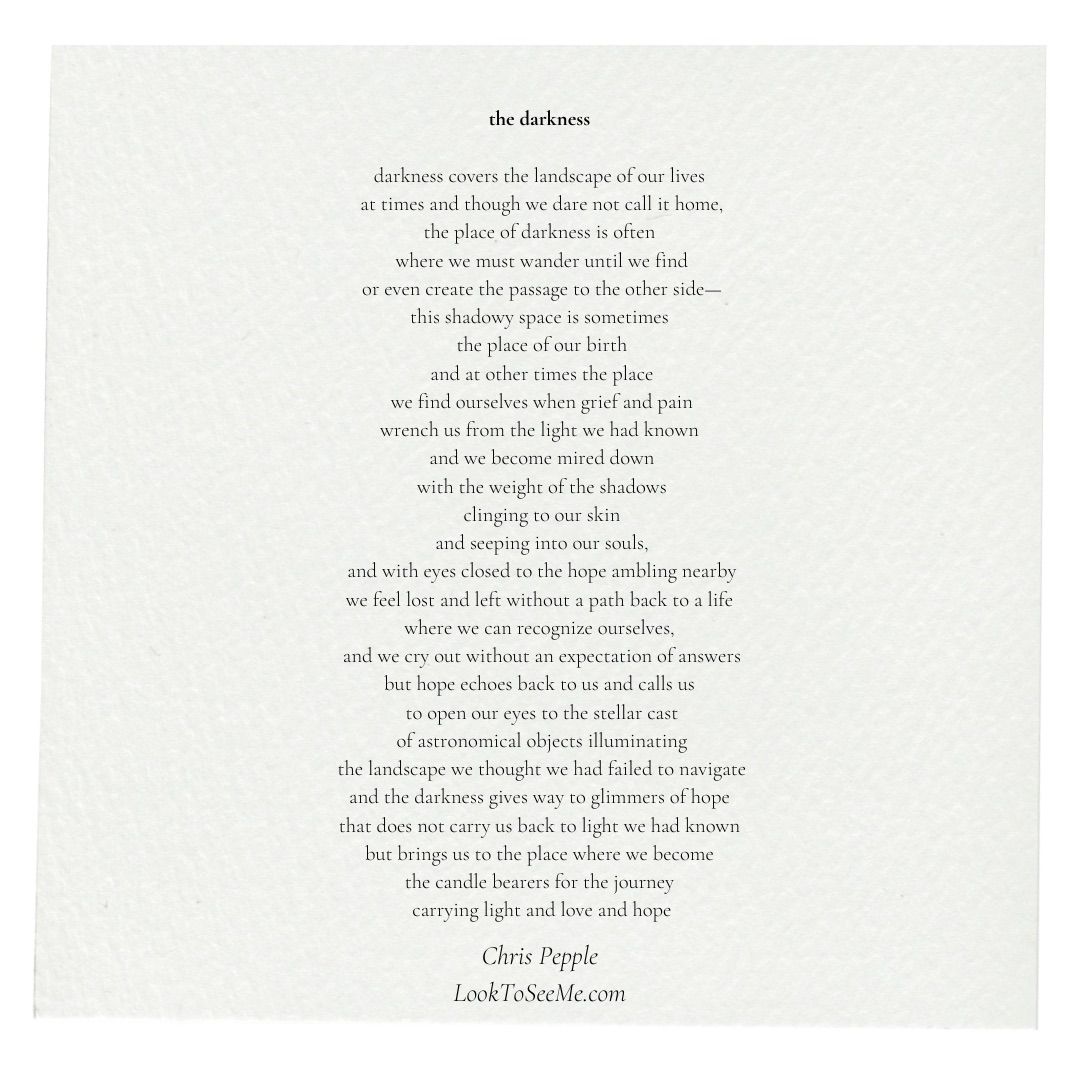
Darkness and Light

I am reminded by multiple friends this week that we are in a season of reflection on our move from light to darkness, fear to hope, grief to renewal.

Several acquaintances celebrated Purim this weekend, reminding me of the story of people moving from fear of annihilation to a moment of salvation. The story of Esther reminds us that an entire group of people were targeted for bullying and death, yet courage and faith brought another outcome.

My Christian friends are walking through Holy Week this week. They will face the story of the death of Jesus, the darkness of the tomb, and the hope of light and resurrection on the other side.

My friends who walk closely with nature are seeing the natural world awaken from the darkness and the cold of winter, finding a renewal through the light of spring and the warmth it will bring.

A young student studying Taoism reminded me that spring helps us to find a balance in life…a balance between light and darkness, cold and heat, stagnancy and movement so that we can find our own place of renewal and strength.

My friends and loved ones in the LGBTQ+ community are searching to find the light in these dark times…looking for hope against all of the laws that are trying to erase their identity. My transgender friends and loved ones face bullying and hate and uncertainty daily on so many levels, often coming from people they thought they could trust…their church friends, their neighbors, their teachers, their elected leaders.

Sometimes we find ourselves in darkness…in times of grief…in times of pain…in times of having a broken heart. We find ourselves torn away from the known and walking through uncertainty. We often can’t return to what we originally saw as light. We can’t go back to the same journey we were on. We are different. The times are different. But hope means there’s a new path waiting for us, a path where we will find love and peace and be able to shine that love and peace for others still searching.

xr:d:DAGAhWOhEdE:5,j:3726025577832761548,t:24032513

Remembering the Love in You:

Transgender Day of Remembrance

We will miss you,

beautiful you,

handsome you,

amazing you,

courageous you

the ones who taught us

to look past

what others misunderstand

and to look past

preconceived ideas of gender

and who found yourself

and declared your truth

despite what others fear…

We hear you,

those who were silenced,

and we see all that is good

and all that is possible…

You were full of possibility

and hope and love.

You spoke truth

to a world who refused

to hear your voice,

but those of us who did hear

will never forget the music

of your life that still

echoes through the hearts

of those who loved you,

those who hugged you

and hoped with you,

those who danced our way

through Pride marches

and those who sat quietly

with you seeking answers…

forever and always,

I will call your name,

the name you chose

and the name denied you by others,

I will call your name out to the world

and validate your truth

and hold on to your memory

because you were loved

forever and always…

—Chris Pepple © 2022

The Dance of the Young Spirits

The Dance of the Young Spirits

I sat outside and pondered

all the lives lost and the grief

of all who are left behind

and I listened to the songs of the birds

floating from tree limbs nearby—

Mother Earth inhales my worries and fears

and carries them on dandelion seeds

that will become the hope for new life 

tomorrow—but for today

She exhales the very winds that

touch my soul on these grief-filled days

when sorrow lays heavy in my heart,

but as daybreak nears, I glimpse

a teacher’s smile and outstretched hand

calling to students who are rising

from the wounds they should never

have had to experience, but now

I see their spirits rise among us

and dance before us with a beauty

that only the forever healed can show

and they encircle us and call us forth

to be the ones to join them in

this dance of the spirits

and to sing their names as we move

free from their dance and as we

face the sunrise without them

and decide how we will walk

into the future with the promise

we whispered to them that

no more would have to join their dance

before their time and no more

names would be written into the heart

of Mother Earth who grieves all who fall

into her arms by the hands of another…

Can you see them rising into the morning

and saying their own names as they

move into their forever without

finishing out their todays…

I hear their names and promise

I heard their pleas…

—Chris Pepple ©2022

Those Who Grow

If you are following my podcast on iTunes or SoundCloud (Look to See Me by Chris Pepple), you can find some of the transcripts of my episodes here.

***

Hi, Listeners! I hope you are all hanging in there this week. I know we are in the middle of some stressful and uncertain times. I do welcome you, though, to this season of Look to See Me, a podcast that invites you to look closer at the lives of people around you and to take time to hear their stories. I’m Chris Pepple and today I’m going to talk about personal growth. 

When we talk about babies, we talk a lot about growth and development stages. When should they sit up? Are they crawling and walking as they should by a certain age? Are they making sounds and forming words? Once kids start school, we focus even more on intellectual growth and meeting academic expectations. Can they read on schedule? Have they developed math skills? Are they understanding basic grammar skills? We also talk about their social skills. Are they getting along with their peers? This trend continues until we complete our education. It’s then that our discussions of personal growth tend to lessen and sometimes even go away. We may still talk about professional development, and if we are religious, we will use growth language when we talk about our faith. But even then we are rarely assessing ourselves to see if we are maturing in any real way. We have formed our life habits by then, and unless we are forced by circumstances to change any of those habits, most people are content to just get through life without much additional work toward growing. 

Through developmental and psychological research, we know that adults have the ability to continue to grow spiritually, emotionally, and mentally. We can break habits, learn new skills, and change our behaviors. We come into adulthood with our life perspectives developed through our experiences and influences beginning in infancy and continuing through young adulthood. We are affected by our family and societal relations, by our educational and religious experiences, and by the technological access and cultural influences from our surroundings. But growth and change are still possible.

Psychologists tell us that the ages between 18 and 29 can be referred to as emerging adulthood. This is a time for individuals to focus on their goals and explore their unique identities and the possibilities that are before them in life. This is also a key time in life to explore our relationships and all of our societal connections to others. In this time, new relationships help individuals realize that they may need to break away from old habits, unhealthy ways of thinking, and prejudices that were handed down from family and friends. 

But what about those of us over 30…over 40…over 50? Are we will still exploring our own identities and thinking about our habits and the thoughts we carry each day? I can answer for me. For a long time, I wasn’t thinking about any of this. I was in all-out survival mode—keeping my head above water physically and financially. I went to Sunday school classes, but I didn’t really assess any of my religious beliefs. The places I went just affirmed what I already believed. I didn’t think much about my larger community. I didn’t spend a lot of energy wondering about what I needed to change in my life. When things were going well, I enjoyed the good times as they were. When things weren’t going well, I just tried to hang on and survive. 

How many of us get stuck in this pattern and never think about the world around us, how we can use our gifts and talents to bring positive changes to our communities, or how we can join in with other community members to improve the quality of life for others while we also increase our own strengths and find happiness in pursuits we had never imagined? 

Changing is so hard. It’s not something we just naturally feel good about as adults. We like many of our routines, or we at least feel comfortable in them. We are reassured by predictability in our lives. So, a first step for many of us involves a recognition that we have not actually grown in quite a while and we haven’t even assessed ourselves lately. Let me clarify here…self-assessment does not mean we get stuck in our patterns of self-criticism. Self-criticism is allowing negative beliefs about ourselves to take over our internal conversations. This actually slows our personal growth because we don’t see ourselves as strong or worthy or possessing qualities or talents that we can share. 

I’m talking about taking time to asks ourselves questions about why we believe what we believe, how can we open ourselves up to new people and new opportunities, and how can we be a person who helps bring positive changes to a hurting world. 

Brené Brown—a research professor, author and public speaker—talks about our next step: a willingness to be vulnerable. Vulnerability is letting go of our need for absolute control. It’s stepping out of our comfort zones and doing something new that forces us into new conversations and exposes us to new perspectives. It brings us uncertainty and emotional exposure. In a 2013 interview with Forbes magazine, Brown says: “Vulnerability is basically uncertainty, risk, and emotional exposure. I was raised in a ‘get ‘er done’ and ‘suck it up’ family and culture (very Texan, German-American). The tenacity and grit part of that upbringing has served me, but I wasn’t taught how to deal with uncertainty or how to manage emotional risk. I spent a lot of years trying to outrun or outsmart vulnerability by making things certain and definite, black and white, good and bad. My inability to lean into the discomfort of vulnerability limited the fullness of those important experiences that are wrought with uncertainty: Love, belonging, trust, joy, and creativity to name a few. Learning how to be vulnerable has been a street fight for me, but it’s been worth it.”

Brown reminds me that vulnerability is worth it because, even though we feel uncertain and exposed at first, we soon discover new joys that new relationships bring. We move from surviving to thriving. We become members of our larger community, and we find ways to strengthen these local, national, and international communities. We also find ways to let them strengthen us. They bring beauty into our lives, and we realize that we bring beauty into the lives of others. 

With vulnerability, we redefine success and stop tying our legacy solely to what we earn or what job we show up to every day. We stop trying to be perfect and try instead to be good and to be kind and to be open to life. We aren’t scared to admit that we need to improve and grow. 

Growth and change take more than just vulnerability. We also have to have courage. The changes I made in my life were terrifying at first. I remember having to walk into a new career at a university in Nashville. I had just moved there as a single Mom and knew no one at all in the city. I had to wake up every day and find the courage to start this new phase of my life. Then I added vulnerability. I sought out new people and new experiences. I stepped out of my comfort zone and attended lectures and even gave some. I learned about the nonprofit groups in the city and the needs of those they served. I took risks and wrote articles while others were unsure about whether or not the stories needed to be told. I learned to walk away from people and places I needed to walk away from, and I learned how to grow again. 

It takes courage to admit that we still have things to learn. It also takes courage to admit that we are responsible for educating ourselves. I admit that I get frustrated when adults just want education on a new topic just handed to them without effort. Kids can’t be responsible for their own education. They need teachers and parents to feed them new information. We have to provide the information and the materials and help them interpret everything new. But as adults, we get lazy at times and still want our own learning to happen that way. 

Well, it’s not anyone’s job but ours to educate us. It’s not a person’s job to educate us about what it’s like to be Black in America or live with deafness or be Native American or flee your homeland or be a woman or face cancer or live with grief or survive abuse. It’s our job to open our eyes and read and research and be vulnerable to this learning. It’s our job to hear new stories and let them soak in. It’s our job to volunteer at the Refugee Empowerment Center or attend their public programs or read their social media posts. It’s our job to read nonfiction pieces by people outside of our own race and gender. It’s our job to use the search tool within a new group and read what answers have already been posted there. It’s our job to read articles written by people trying to overcome homelessness. The information is already there. We don’t need people to feed it to us. We just need to learn to use reliable sources, to stop misinformation, and to use what we find to grow. 

Your challenge this week: be vulnerable and courageous in a new area of your life. Do at least something simple like reading an article written by someone of a different race and one by someone whose life perspectives may be different from yours. Explore recipes from another culture and read the history behind the recipe. Read books written by those working in the nonprofit world such as Becca Stevens who works with Thistle Farms. Read fiction and nonfiction pieces which expose you to new perspectives. Start a Zoom meeting with people you have never met in your community. Be open and vulnerable to learning. Those who grow make a difference…those who grow are changed for the better and bring changes for the better. 

Thanks for listening to this episode of my Look To See Me podcast. I hope you return soon.  Be well and stay safe. And remember: You are loved. 

It Was Me

It Was Me

I am the one that 

was raised to be

part of the problem…

who was raised to stay 

on the white side of the street

and who was raised to label 

everyone in conversations…

“the black family on the street”

“the Muslims one street over”

“the Jews who live in the cove”

“that Indian man who owns the store.”

I learned all the assumed adjectives…

lazy, cheater, thug, thief, 

will steal you blind…

and I learned that people 

hired you for cheap labor

but never appreciated your work…

Then I met you…it was a new world…

you were smarter than me in trig class…

you tutored me, you taught me about life…

you were the coach of my team…

you doctored me back to health…

you befriended me…

you were there when I cried…

you taught me to get back up…

I learned your history and saw

everything wonderful and strong about you…

and I had to live with the fact that I 

never spoke up before now…

I was raised to be part of the problem…

my silence allowed your beatings and death…

the labels stripped you of your seat at the table…

the lies about you took away your hopes and dreams…

And my silence never brought change…

But I promise you now

I will roar for you

and film the wrongdoing

and call out the racism

and name it

and pray for change

and work for change

and be the change

though it will never

bring lost ones back to life

or heal the wounds from beatings

or restore all that you have lost…

but I will lose the labels

offer respect

fight for justice

and never be silent again.

–Chris Pepple ©2020